Showing posts with label filler. Show all posts

Friday, February 27, 2026

Pokemon isn’t OSR (but I wish it was)

Warren over at Prismatic Wasteland recently made a post titled: “Pokemon is OSR”, and in the storied tradition of bloggers everywhere I am writing a response to say “the fuck are you talking about, man?” 

(note: Warren actively encouraged this)

To start, I am going to open with the ways that I think Pokemon could fit into the broad and increasingly dissolved umbrella category of OSR:

1. The damage calculation formula is the work of a madman

Using an over-complicated rule for one of the core verbs of the game isn’t OSR directly, but it is in line with the source material the OSR was based on. Actually, now that I say it, this is actually evidence that it isn’t OSR, because that formula hasn’t gotten any less insane in 3 decades.

2. Thirty years without meaningful change

OSR, not NSR. Pokemon the series is a self-devouring Soroboruo, eternally retreading the same ground with either minimal nonstructural change or immediately abandoned mechanical additions. There was a new Pokemon game announced yesterday and once again it’s another fire-water-grass trio. Fighting-psychic-dark is still right there. 

There's also the matter of fangames and spiritual successors, which I say are more OSR than the mainline because they're all about hacking the weird old kludged-together spaghetti-code of an elder game series and seeing what can be done with it in novel ways.

There’s the reasons for, here’s the reasons against as I see them:

1. Screaming into the Void

Pokemon battles don’t exist in a place. I think this is easily the most damning argument against their OSR-ness; the battle screen is a featureless void (or may as well be) that only takes into account the broadest environmental factors (weather) and simply doesn’t contain anything like positioning, cover, or environmental objects. There are no lasting effects on the environment after a battle. Creatures do not exist before or after the fight. There are ambushes, but not mechanical ones; a trainer might jump out from behind a tree or a rock, but that doesn’t have any impact on the fight. Pokemon battles are incredibly fair - a good quality in a game for children, not so much in a genre where the approach to combat is “cheat like a motherfucker with every tool at your disposal.”

2. 1-v1 me IRL

Further reducing the tactical considerations is the 1v1 default of most combats. Benched Pokemon can’t do anything, they have no active effect on the battle. If this was a dungeon crawl, it would be as if you were playing as a doppelganger flipping between impersonated adventurers on the fly (this is cool idea, gonna make a note of that); 2v2 battles and the long-abandoned 3v3s add “some moves can hit both enemies, and some can also hit your partner”, but there’s nothing beyond that in terms of what choices you are making in a given moment. Roles do not change during battle, non-battle actions can’t occur during battle, and you can’t coordinate the different members of your team into a cohesive unit. 

3. A Sequence of Repetitive STABbing Motions

Last of the issues in the battle system is Pokemon’s default winning strategy: you spam a high-damage move with Same Type Attack Bonus at anything not resistant to it until the bar hits zero. Surf, Earthquake, Crunch, Flamethrower, Psychic, Icebeam, game, set, match. This only gets shaken up when variant rules are thrown in (Battle Frontier) or you’re playing against your local psychopaths I mean competitive Pokemon players. Maybe sometimes you’ll use a status effect, or end up using something off the wall, but for nearly every fight in the game it’s just a DPS race.

4. A World of Limited Applications

But what about outside of battle? There are, according to Bulbapedia, 19 field moves, which can then sort into the following categories:

  • Obstacle removal: Cut, Rock Smash, Strength
  • Movement: Fly, Surf, Dig, Dive, Teleport, Rock Climb, Whirlpool, Waterfall 
  • Healing: Softboiled, Milk Drink 
  • Encounter Triggers: Sweet Scent, Headbutt
  • Environmental: Flash, Defog, Secret Power
  • Teaching your Chatot curse words: Chatter

Two of these have appeared in only one generation, and two more have appeared in one generation and its remake. They are quite limited in terms of their effects, with each move being applicable in one specific scenario each. (Strength can only be used to move rocks, you cannot pick up a car and use it as an improvised weapon, for example) Several are essentially slightly-modified reskins of each other. 

Early generations required the use of the “HM slave”, the pokemon you dumped all the field moves onto so as not to waste slots on your A-team; later games have gotten rid of this with just allowing you to use it at any time so long as the HM is unlocked; neither system allows for any usage outside of the predetermined pacing and location. 

5. Random encounters are one cool thing and 99 stupid birds

It feels good to stumble on a rare Pokemon while out in the wild; every other encounter is nothing. A fight with a wild pokemon contains no meaningful interaction with the world - there are no factions who will take notice, no spoils to take home: unless you catch something useful, you get some XP and that’s it. The drain on your resources will be minimal, since a type advantage + level parity basically means you’ll be 1 and 2 shotting everything, and you likely have more than enough ethers to get to the next town (or you can just fly back to a Pokemon Center at no cost to you.) 


But What if it Was...

So, if you wanted to make Pokemon OSR-ish, how could it be done?  I’ve got some ideas.

Most of these are going to involve re-doing the movelist.

  • Give every Pokemon an inherent basic attack that upgrades its damage die as they gain experience. All the flat upgrade moves (Scratch and Slash, for example) are now the same move, separated by type and physical/special as appropriate.
  • Attacks that trade self-damage or lower accuracy for higher damage are now just mechanics that you can invoke whenever (Take Down is merged with the Tackle series, Fire Blast is merged with Ember-Flamethrower)
  • Most status moves can be kept; most stat changing moves will probably be tossed 
  • We now comb through the adjusted list and see which ones have a clear use-case outside of battle. If one isn’t obvious but we can make up something for it, still works.
  • Merge and dump moves until satisfied; ideally, only a few of the most basic attacks will have no additional use-cases, and even then that’s what rulings are for.
  • For funsies, start incorporating Pokedex entries

This will solve most of the issues I listed above - the environmental aspects are solved by moving it out of a video game and into the theater of the mind where you have multiple players and an environment to interact with.

One final note: if we’re doing OSR Pokemon, it's going to inevitably become OSR Shin Megami Tensei. We've got the Ars Goetia and the Gazu Hyakki Yagyō right there.

Also you don't need a dedicated class, these are just wizards and their spell weasels. 

Sunday, October 6, 2024

Five More Forgotten Fictional Fantasy Novels

Kurt Vonnegut once said in an interview that he invented Kilgore Trout so that he could provide pithy, entertaining summaries of books without having to write them. The method works; people like reading these sorts of posts, and I like writing them, so they shall continue.

Previous posts:


The Unseen (Dressel, Oscar. ~1936)

An unfinished and unpublished novel recounting an unnamed narrator's encounter with, attraction to, and eventual obsession with a man that only he can see. Haunting, dreamlike prose is accompanied by feverish charcoal sketches. The narrator eventually finds that his dreams are intruding upon reality (or that he is slipping into his own dreams), but this narrative thread reaches no conclusion; Dressel,was accused of homosexuality by a neighbor in 1938 and imprisoned at the Buchenwald concentration camp. The single known manuscript, which contained Dressel’s editing notes for the first 33 pages, was anonymously delivered to the University of Vienna in 1995.


Ruckus and Puck (Fisher, Elizabeth. 1962)

A short comedic adventure for younger readers, featuring the two titular squires as they gallivant their way across a parody of Arthurian romance. Among their escapades they bumble through rescuing a pair of princesses, fail to slay a dragon (though they beat it at euchre), and manage to outwit a sociopathic Sir Percival in order to recover one of the water pitchers of the Last Supper. The sequel novel, Kat and Pat, was released a year later and followed a similarly silly adventure undertaken by the princesses from the first book.

While well-received by readers, the books did not find much audience; the novels received a single printing each before Fisher’s sudden death in January of 1964, and sales were not deemed sufficient for a second. Physical copies are extremely rare and no official ebook version was ever made, though scans are easily available.


Myth-Cycle of Ancient Zanul (“Zagdu the Sage”. ~1924)

Nearly 3000 pages of supposed mystic-historical texts of an ancient, technologically advanced Indo-Aryan civilization. The work purports to be the translations of texts discovered in a Nepalese monastery by a Cambridge anthropology professor, but is in truth authored by career grifter C.K. Neal in the hopes of defrauding wealthy theosophists. The manuscript was never used to that end, as Neal was stabbed to death by one of his previous scam victims before he could shop it around. It wasn't discovered until over 80 years later, in the bottom of a cedar chest pulled out of an abandoned storage unit by a great grand-nephew.


Ruby in the Rosebush (Roman, Jessica. 2018)

Infamous in the romantic fantasy subgenre for its third-act twist; at the climax of the plot, the female lead discovers that her elf lover had been directly influencing her mind since their first encounter, that he was a fetishist for centuries-long age-gaps, and that he had used his aristocratic station to get away with this multiple times before. She immediately follows this revelation by smashing his brains out with a marble statuette, setting his manor on fire, and running off into the night. The sequel novels switch gears entirely to a crime procedural where the elf gendarme are dragged into a cross-elfland cat-and mouse hunt with “the Whippoorwill”, culminating in a peasant uprising that obliterates the elf aristocracy and a one-woman assault on the fortified manor of the King of Green Leaves.

Roman shut down the entirety of her online social media presence during the summer of 2020, citing burnout and stress. This was in part for the obvious reasons, but was certainly exacerbated by her combative persona, fiery opinions, and regularly finding herself in the middle of Book Twitter Discourse (As one can easily tell from Ruby, Roman had low opinions of romantic fantasy genre conventions) She has not resumed online activity as of 2024.


The Naqdor Affair (Folger, Bernadette. 1998?)

A novel of the Star Wars expanded universe, the existence of which is known only through a 2004 interview with a former editor for Bantam Books. This interview contained only the following details, all unsubstantiated by Lucasfilm Licensing or Bantam.

  • The book was described as a “political paranormal horror” novel, centered on Leia Organa and a new character named Togi Panar.
  • The book was set in 20 ABY, directly after Timothy Zahn’s Hand of Thrawn duology .
  • The book was draft-complete, though still in the editing process, when it was canceled.
  • The explanation provided by Lucasfilm was that it “didn’t fit” with their plans for upcoming novels.

From these crumbs came a persistent conspiratorial cottage industry of dedicated internet sleuths attempting to find any more information, any at all, about the book. Wild theories bloomed on Star Wars discussion boards. One dedicated adherent wrote over 60,000 words attempting to glean potential references to the novel that had been snuck into the Prequel trilogy and reconstructing it from these supposed traces. Rumors of the book’s content grew increasingly lurid, often bordering on the obscene. Extreme violence and sexual content was treated as a given, despite the total lack of evidence to suggest it.

This continued without much development until the summer of 2009, when an anonymous poster on 4chan’s literature board began a thread titled NEW INFO ON NAQDOR AFFAIR - BERNADETTE FOUND containing several potentially ground-shattering claims:

  • Bernadette Folger was a pseudonym.
  • The novel was intended to set up a multi-book storyline with a new major antagonist.
  • The actual reason for the cancellation was still under NDA, but it did not involve graphic content.
  • There had been a romantic subplot involving Togi Panar, but it was cut before the book was canceled. The emails don’t mention who the other party was (this only emboldened the Togeia shippers.)

Three photographs of typewritten manuscript pages were included in the thread, supposedly from “a draft old enough that they won’t come after me for it.”

  • Page 1: Leia is waiting for Togi to arrive at a grav-train station on an unnamed planet (it is unclear if this is Naqdor - it is described only as “a jagged expanse of gray, dead stone under a dead gray sky, interrupted only by the soft tumor-like shapes of brown-black fungi”). Leia is depicted contrary to her typical imagery, wearing a leather jacket and smoking a cigarette. Togi does not appear by the end of the page.
  • Page 2 - Presumably from somewhere in the middle of the book, this page is nearly entirely dialogue between Togi Panar and a character named Yo-Chimmak. Stripped from context, the conversation is obtuse and hard to follow, though it seems to be about some Force-related entity or principle called the Kulut.
  • Page 3 - An action sequence where Leia flees from an unknown assailant that had broken into her diplomatic quarters (presumably on Naqdor). No details are given on the killer besides “even with two arms and two legs, it moved in a way that humanoids cannot and do not.”

Following this, OP leaves the following comment:

“hold on a couple minutes, I have to type something out”

They do not post again in the thread.
 

Saturday, August 5, 2023

10 Additional Planets in the Solar System

Why not, let's throw some extra planets in here.

1. Vulcan

The large, volcanically-active moon of Venus. Hazy atmosphere of mostly C02, and other carbon and sulfur compounds. In extremely close orbit with its parent world.

2. Juno

The 5th Galilean moon: a superterrestrial world of 2.6 Me, with a thick atmosphere of methane, nitrogen, CO2 and ammonia. Frozen, but not as cold as it would otherwise be expected to be, thanks to atmospheric insulation and moderate tectonic activity maintained by the tidal stresses of Jupiter.

3. Janus

A small, rocky world within the orbit of Mercury. No atmosphere to speak of. Tidally-locked to the sun, which has rendered the solar pole a sea of molten stone and metal.

4. Poseidon

A 3.1 Me waterworld between Mars and Jupiter. Dense CO2 and water-vapor atmosphere. Lack of free oxygen indicates that, if there is any life on the planet, it has not evolved photosynthesis or an equivalent process.

5. Apollo

Earth's second moon; a metallic asteroid not even big enough to maintain a spherical shape. A captured body of drastically different composition to Luna, containing economy-devastating amounts of rare earth metals in easy reach.

6. Ixion

A brown dwarf in the Oort cloud, possessing a cluster of small, icy moons. One of these is in close enough orbit that Ixion's radiant heat and tidal stress is sufficient to keep it an icy slush.

7. Dionysus

Captured planet of primarily ethenol ices. Wobbly, extremely elliptical orbit likely to collide with, be captured by, or ejected by Saturn at some point in the future.

8. Athena

A rocky world similar to Mars in terms of size and atmosphere, located among the Greek Camp asteroids at Jupiter's L4 point. Pockmarked surface from eons of meteor impacts, has four surviving moonlets.

9. Hestia

Terrestrial world of 0.62 Me located in Earth's trailing L5 point. Has a somewhat sparse atmosphere and does not appear to have surface water, but there is oxygen and water vapor in the atmosphere and that has people very excited indeed.

10. Persephone

A moon of Pluto. Far too dense for its size and apparent composition. An icy crust sits over unknown contents. There is no proof that it is artificial, not yet, but...

Sunday, July 30, 2023

MOSH: Appendix M-DAN and the Mothership Soundtrack

APPENDIX M-DAN

Kill Six Billion Demons (Tom Parkinson-Morgan)

Cowboy Bebop (dir. Shinichiro Watanabe)


Prophet (Graham, Roy, Dalrymple, Milonogiannis)


Hyperion (Dan Simmons)


Andor (dir. Tony Gilroy)


Dorohedoro (Q Hayashida)


Children of Time (Adrian Tchaikovsky)


Book of the New Sun (Gene Wolfe)


Atomic Rockets (Winchell Chung)


Orion's Arm


SCP wiki, series 1-3


Citizen Sleeper (Jump Over the Edge)


Prospect (dir. Zeek Earl & Chris Caldwell)


Ghost in the Shell: Stand Alone Complex (dir. Kenji Kamiyama)


Delta Green (Glancy, Detwiller, Tynes)


Disco Elysium (ZA/UM)


Signalis (rose-engine)


Hardspace Shipbreaker (Blackbird Interactive)


Halo Reach (Bungie)


Mass Effect (Bioware)


Eclipse Phase (Posthuman Studios)


Seedware, Farcast, H-Rep (Wallace, Derie, Unit Omega)


Mothership the Soundtrack


Unlike with the MSF soundtrack, the majority of these don't have dedicated components or an order, and so I have left out the meta-titles. And also the links because that was a pain and a half the first time.


e. Ivy has very graciously made a spotify playlist of most of all of these.

[1] "Copy that, Oriole, you're cleared for docking on spur 43. Welcome home."

[2] Had to limit myself on the Bebop tracks, otherwise the whole list would have been just that soundtrack.

[3] Same as [2].

[4] Friday night at the ISWU Local #975.

[5] Drinking away your paycheck.

[6] Theme of the Panan Sho syndicate.

[7] This song could be a total hoax and I would not care - it's a great story.

[8] Raid on the deepwell blacksite.

[9] Hans Zimmer has never gotten over this song and has been trying to recapture it for a decade, and has failed continually. Also the theatrical version had to be reconstructed which is bonkers nonsense.

[10] Orbital drop over Sigma Draconis d.

[11] I don't think there's a better exncapsulation of cyberpunk than this song and the scene it is from - nothing short of a dirge for the world.

[12] Clawing ever upward towards liberation.

[13] Many thanks to MickyJim for this rec - I haven't played any of the 343 Halos so the music gets to be only rarely.

[14] The Zeruel sequence is easily my favorite example of cosmic horror in media. The time of Fucking Around is over; now it is the age of Finding Out.

[15] I don't think there's a track in existence that is more poorly served by its accompanying material than this. It deserves some K6BD level magic kung fu bullshit.

[16] Bioware was aiming way higher than their weight class with Sovereign, and boy did that bite them in the blubber later down the line.

[17] A Jovian slingshot followed by a 3G burn. Ramming speed.

Saturday, June 24, 2023

5 Forgotten Fictional Fantasy Novels

Your local Book Club Witch is back in town, let's see what she's got on offer.

 1. The Lion's Banner (1948)

After his death, a critic called Edward "Ed" Marsh "America's forgotten Tolkien" - a title Marsh would have rejected, but not an entirely untrue one. The Lion's Banner and its sequel (Last Campaign of the Lion's Banner) are accounts of a mercenary company inspired by the author's experience as an infantryman during the the Italian theater of World War II - some characters, scenarios, and dialogues are, according to Marsh, 1:1 translations of reality. The world of the novel is a loosely sketched fantasy Mediterranean in the wake of an imperial collapse, drawing many elements from Greco-Roman myth and history (down to a wildly popular messianic cult emerging in the background) and occasionally interrupted by incursions of alien and incomprehensible powers. The narrative points of view are universally either footsoldiers or camp followers - the kings and generals leading the Thousand-Crown War are portrayed as distant and inscrutable beings, even further removed from common humanity than the gods. This, along with other socially-aware elements uncommon (but not unheard of) for the time period have fueled a small but devoted modern following. 


2. Durac the Swordsman, Hero of Zaag (1976)

At first glance, it is a pornographic pastiche of the John Carter series. Closer reading reveals a rather brutal personal reflection on loss, addiction, mortality, and the failures of the counter-culture movement. Both Durac and the Zaaganian princess Moroque are trapped in self-destructive spirals of their own making; while the warlord is defeated, the protagonists' futures do not look particularly bright or lengthy by the end of the book.

Critical analysis of the book tends to put a great focus on the life of author John Duke. Duke's wife had committed suicide in 1973 and this was the source of much of the nihilism in Durac and its three sequels. It also accelerated Duke's already-severe alcoholism, which would lead to his own death in 1981. 


3. The Bloody Pearl (1926)

A rip-roaring pulp pirate adventure starring Siobhan O'Toole, Terror of the Crown, in her quest for treasure and revenge across the Caribbean. Written by schoolteacher Mary Hammet under a pseudonym, the book has frequently found itself challenged or banned due to its depictions of sexuality, violence, and unladylike behavior. It was most often challenged because of the interracial relationship between O'Toole and her longtime rival/friend Jean d'Capiteur. These challenges eventually escalated to a 1951 obscenity trial in which Hammet was forced to reveal her identity as the author. The trial did not go in her favor (she was declared in contempt of court for her combative responses to the prosecution and refusal to recant her statements) and as a result she was effectively blacklisted from publishing for the rest of her life. In her later years, she devoted herself as an ally of the civil rights movement (following in the footsteps of her abolitionist grandmother), participating in marches up through 1963 mere months before her death at the age of 85. As copyright was not renewed for The Bloody Pearl and the other Siobhan O'Toole novels, they were unaffected by the 1976 Extension Act and fell into public domain in the mid to late 50s, but have only recently had a resurgence in popularity thanks to efforts of Hammet's great-grandson.


4. And the Birds Cry Havoc (2007)

An early exemplar of the modern queer body horror and splatterpunk genres, And the Birds Cry Havok was published online in irregular serial installments beginning in June of 2007. Its grotesque, dreamlike, and chronologically asynchronous narrative details the incursions of "teratomatic space" into our world and the resulting influence of a decadent and brutal "meat-fascist" state.


While the story gained a small and devoted following, updates stopped without explanation in October of 2009, leaving the story unfinished midway through the fourth of five acts. Communication with the already-reclusive author gunkbird also ceased at this point, and episodes of dedicated sleuthing turned up nothing. The website ceased operating in 2012, and with only partial coverage on Internet Archive the story was thought lost until a reader stepped forward with a self-compiled pdf copy. The fan community, including several of the "sludgies" (earliest adopters) later produced a version with better formatting, commentary essays and art, which is available on multiple storefronts as a pay-what-you want purchase, with proceeds going to organizations serving at-risk queer youth.


5. "The Saga of Eric" (2014-2019)

A glimmer of creative genius shining even in the depths of capital's all-devouring machine, the "Saga of Eric" would have gone completely unnoticed by the world were it not for a stray Reddit post pointing out the apparent continuity between two commercials for BKO Insurance. Smelling a treasure hunt, a small community formed around these hidden links and visual gags, and swiftly pieced together that there was indeed a meaningful narrative beneath the bizarre non-sequitors and inane advertising tag lines. As theories gained footing and new commercials aired, the sleuths pieced together the outline of a greater narrative of Eric (the everyman spokescharacter)'s life. Over the course of the commercial series (told anachronistically), we see Eric struggle through the loss of his job, the collapse of his toxic codependent marriage, his brother's cancer diagnosis, a backpacking pilgrimage through Europe, the rescue of his son from online radicalization, and his relationship and eventual (much healthier) marriage to his second wife, all interlaced with alchemical imagery building towards the Magnum Opus.

BKO insurance was bought out in 2019 and the Eric commercial series was shuttered. No one has come forward to claim responsibility for writing them.

Friday, June 16, 2023

100 Good Words

Wiktionary has an archive of non-English words of the day. I was bored one evening and started going through at random, pulling out some of my favorites. Might as well make a random table.

Since these are all trawled from Wiktionary, apply some salt as you deem necessary. Turns out if the language uses a non-latin alphabet it is very difficult to find an entry again after you lose the link so I might be missing some of the diacritics.

100 Good Words


    1. -pháka (v): 1) to serve food 2) to distribute, allot (Zulu)
    2. āghāya (n): n) killing, striking, stroke, blow (Prakit)
    3. ahava (n): 1) cold wind 2) weather-beaten skin (Finnish)
    4. ajatasten Tonava (n): "Danube of Thought"; person with many pointless thoughts (Finnish)
    5. àlmājirī (n): 1) student, often itinerant 2) beggar (Hausa)
    6. āltepētenāncoyoctli (n): small gate in a city wall (Classic Nahuatl)
    7. amiqui (v): to die of thirst; to be thirsty; to drown (Nahuatl)
    8. ana-baci (n): 1) mother and sister 2) a man's sense of honor (Azerbaijani)
    9. anniskelu (n): the serving of alcohol 2) saloon, pub (archaic) (Finnish)
    10. apenrots (n): 1) a rock on which monkeys live 2) a silly hierarchical environment (Dutch)
    11. armentum (n): draft animal suitable for a plow (Latin)
    12. åskblå (adj): dark grey-blue, as a thunderstorm sky (Swedish)
    13. atakanar (v): to fix, to repair 2) (reflexive) to dress up (Ladino)
    14. auzhandil (n): morning star, Venus (Gothic)
    15. avoda (v): 1) worship, service 2) work, job, labor (Hebrew)
    16. ayiq (adj): 1) sober 2) conscious, awake 3) vigilant (Azerbaijani)
    17. ayni (n): community work, mutual aid; solidarity (Quechua)
    18. bacōnālis (adj): fit for bacon (Latin)
    19. blāc (adj): pale, shining, white (Old English)
    20. boia (n): 1) executioner 2) hangman (game) 3) scoundrel, villain (Italian)
    21. borken (v): 1) to bark 2) to grumble or whine 3) to complain or insult (Middle English)
    22. bplòt-ɛ̀ɛk (v): to liberate from oppression, or servitude. Lit.”to remove the yoke” (Thai)
    23. buraxmaq (v): to let go; to release; to let; to leave; to publish; to let through (Azerbaijani)
    24. chronophage (adj): time-consuming (French)
    25. chumbo (n): 1) lead 2) shot, pellet 3) failure 4) rejection (Portugeuse)
    26. cindṑ (n): someone with six fingers on each hand (Hausa)
    27. csufnev (n): unflattering nickname based on a characteristic or event (Hungarian)
    28. dabbaja (v): 1) adorn, deck out, embellish 2) to express splendidly (Arabic)
    29. diskabresta (v): to lose self-control (Kabuverdianu)
    30. djodjomano'o (v): you (several creatures) shut your eyes (Tonkawa)
    31. dodo (n): 1) being a deep, rich red 2) fried plantain (Yoruba)
    32. dvärgalåt (n): petty, unmotivated criticism (Swedish)
    33. dygna (v): to stay awake for 24 hours (Swedish)
    34. dzjákuj (int): thank you, thanks (Belarusan)
    35. gaduji (adj/n): adj) all together n) collective labor (Cherokee)
    36. gadzinówka (n): local-language newspaper serving an occupying force (Polish)
    37. gallicinium (n): time of early morning when roosters crow (Latin)
    38. gatarî (n): 1) a multitude of cats 2) a long meow (Emilian)
    39. Gedankenwelt (n): the world of ideas (German)
    40. glodomór (n): one who is constantly hungry; one who is starving (Polish)
    41. hero hero (n): red, crimson (Rapa Nui)
    42. ḥina'iḏin (adv): then, at that time (Arabic)
    43. hoyreg (n): murder victim; corpse (Yiddish)
    44. hranrād (n): "whale road"; poetic kenning for the ocean (Old English)
    45. ikara (v): 1) to sit 2) to stay / remain 3) to dwell (Kikuyu)
    46. ixuxu (int): 1) battle cry or challenge 2) cry of joy or excitement (Asturian)
    47. jǐngdǐzhiwā (n): person of limited life experience; (Modern Standard Chinese)
    48. kagiroi (n): 1) heat haze (archaic) 2) the glow of dawn (archaic) (Japanese)
    49. karadaki (n): heating empty cookware (forgetting to fill the kettle, etc) (Japanese)
    50. kokolares (n): nonsense, balderdash, gibberish (German)
    51. krāntikāri (n): a revolutionary (Hindi)
    52. kulukulu (n): 1) the smell of raw meat or fish (Saetomense)
    53. kümütüdi (n): termite nest in which the placenta of a newborn is buried (Maquiritari)
    54. lankous (n): familial relationship to spouse's brother (Finnish)
    55. ling-lôot (v): "monkey-jumping"; to be overjoyed (Thai)
    56. lletraferit (adj/n): adj) well-read, bookish n) book-lover, "book-smitten" (Catalan)
    57. lodikor (adj): likely or tending to become fat (Basque)
    58. lyard (adj): having dappled grey and white spots (Middle English)
    59. madro (n): peace or silence after a meal (Danish)
    60. malandrar (v): 1) to get by at others' expense 2) to do nothing productive (Portuguese)
    61. malaya (int): expression of annoyance or unpleasant surprise (Asturian)
    62. manželée (n): married couple (Czech)
    63. marambaia (n): landlubber (Portuguese)
    64. matasanos (n): quack doctor (Spanish)
    65. māyā (n): 1) art, wisdom, inhuman/supernatural power (Vedic Sanskrit)
    66. mimochodem (adj): 1) by the way 2) en passant (Chess move) (Czech)
    67. mnkhwani (n): pumpkin-leaf relish (Chichewa)
    68. mokutō (n): 1) a silent prayer 2) to offer such (Japanese)
    69. nekás (n): 1) pile of corpses 2) line of soldiers 3) the dead (Ancient Greek)
    70. nunu (conj): now then, therefore, consequently (Gothic)
    71. nyan (v): to see vaguely (Abau)
    72. ouranóthen (adv): from heaven (Ancient Greek)
    73. panero (n): someone who loves bread (Spanish)
    74. pāngtuó (adj): 1) of rain, torrential 2) of tears, streaming, 3) vast, plentiful (Chinese)
    75. pāthnā (v): to press cakes out of dung (Hindi)
    76. pekoral (n): a text written in a pompous, grandiose, ridiculous style (Swedish)
    77. pócima (n): potion (Spanish)
    78. pruikentijd (n): "Wig Era" - humorous/informal/pejorative name for 18th century (Dutch)
    79. śaraṇārthi (n): 1) suppliant, petitioner 2) refugee (Sanskrit)
    80. sbarazzino (adj/n): adj) impish, cheeky, mischevous n) scamp, imp (Italian)
    81. sebu (n): used-media store (Brazilian Portuguese)
    82. shashimamishi (adv): haughtily, arrogantly (Swahili)
    83. shilah (n): 1) Elder sibling of opposite gender 2) maternal cousin (Navajo)
    84. sôtôrôkôm (adj): "hundred-fold" (Bengali)
    85. suppēdō (v): “I fart quietly” (Latin)
    86. tabanka (n): performance of theft of a saint (represented by a flag). (Kabuverdianu)
    87. ṭaqs (n): 1) weather, climate, forcast 2) religious rite (usually in plural) (Arabic)
    88. tausi (n): a grand, a thousand Euros (slang) (German)
    89. teōpixqui (n): priest, lit. “god-guarder” (Classical Nahuatl)
    90. thokar (n): 1) striking an object with the toe 2) loss, injury, damage (Gujurati)
    91. tlīlātl (n): abyss; deep water; ritual healing water of Ixtiliton (Classical Nahuatl)
    92. tsindn (v): to light, to kindle (Yiddish)
    93. ūhtcearu (n): pre-dawn anxiety (Old English)
    94. ungkeurida (v): 1) to crouch 2) to exist in a suppressed or hidden state. (Korean)
    95. valtr (adj): easily upset; unstable, unsteady (Icelandic)
    96. xalāsi (n): 1) railroad worker 2) dockyard worker 3) menial fisherman (Hindi)
    97. xìyǎn (n): most interesting part of an opera or film (Modern Standard Chinese)
    98. yibatha (n): a female marriage class / skin group (Gamilaraay)
    99. žāč̣ă (n): beard (Adyghe)
    100. zamordyzm (n): authoritarianism (informal, derogatory) (Polish)

Friday, May 12, 2023

10 Genders from Fantastic Lands

 1. Yymuqat - Those dedicated to raising and teaching children are explicitly gender-neuter,as are their charges. These creche-keepers are often inaccurately described as eunuchs by outside cultures; they might become male or female, marry, and have children of their own, with the choice to return to their neutral status after the infant has been transferred to the appropriate creche-home.

2. Ayonzanyi - Forges are female, and thus the art of creating things within them is a masculine trade. Thus, when one born as a woman feels the call of metalwork, she might declare herself as ayonzanyi upon reaching menarche. From this point onward he is legally and socially a man with all rights and responsibilities that entails. Some ayonzanyi will undergo full bodily transition, but most will remain as they were born.


3. Tsimashi - Male and female are treated as broad, generic categories containing an effectively-endless number of descriptive epithets, facilitated by the condensed complexity of polysynthetic language. These inner names are might come and go according to the tides of life; they might be declared or given, discarded or recovered, changed or expanded. No one is simply man or woman, but one of countless experiences of the world.


4. Caibilix - In noble families that have no daughters to inherit, it is traditional for the eldest son to assume and fulfill the role. She will be married to an eligible man of another house and a peasant woman (discrete and well-paid) will be found to serve as surrogate. The caibilix will act out mock-pregnancies in full, including ceremonial labor, from which she will emerge with the newborn. When an inheriting daughter reaches age of majority, a caibilix may return to male, though many will elect to remain as they have been.


5. Savikra - Individuals who have mantled a spirit of another gender through an istâdan-bond. This is most commonly found among practitioners of familial necromancy and those artists who make muse-pacts. The bond-maker will retain their preferred identity after mantling, but as they are now privy to greater insight of the world, they exist in a slightly different social context


6. Khothridokht - A priestly caste devoted to serving as paramours of the gods during ritualized sexual encounters. As their partners are divine, demigod children might be safely sired by any human parties involved (it's a miracle!). They are expected to act as submissive, recipient partners; any deviation from this role is noteworthy, and considered a portent that will be analyzed by the sooth-sayers for years to come.


7. Elf, Dwarf, Orc - There is a lot to unpack here. Initially, these began as fads of the nobility a few centuries ago during the height of the elfmania that gripped the aristocracy. Imitation of the elves became the fashion of the hour; dwarves and orcs were soon to follow. Evocation of these peoples through aesthetics of dress or architecture or art evolved into attempts to channel the entire culture as an alternative to existing social structures. This extended to gender and sexuality - Elves were considered haughty and effeminate; dwarves secretive and private; orcs rough and dominant. All three were commonly syncretized into the homosexual relationships of the nobility (socially unacceptable at the time, but not particularly punishable due to noble privilege)


But none of that was based on actual elves, dwarves, and orcs (or rather; kutalmas, mnaqqal, and jaratho). The cultural trappings that became associated with those peoples were skewed from their orginal forms, sometimes beyond recognition. Lies and half-truths abounded. When meaningful connections were made, the images of elves, dwarves, and orcs that had been built by the human nobility - even in places where that nobility no longer existed - were so ingrained that it would be near-impossible to overturn. This has proven a long-simmering source of conflict between peoples.


8. Thaumatine - Big hat. Cool robes. Obscured face. Glowing eyes. Who needs to worry about gender when you have overwhelming magical power? No one is entirely sure where the aesthetic originated, though the leading hypothesis is that it began as protective clothing used by laboratory alchemists in former centuries (protective garments, heavy gloves, sturdy boots) combined with a sorcerer's self-protection precautions (obscuring face and concealing name from other wizards), the accouterments of university doctoral programs (funny hats and robes), and the eccentricities of those who have phenomenal cosmic power (stars, sigils, all that boffo).


9. Lapocoa - In this culture the greatest divide between man and woman is language, with each gender diverging into its own private dialect separate from public speech. Continued social coherence is dependent on translators who can switch between the two modes of speech and in doing so, freely transition from one gender to the other without any change of outward presentation.


10. Five Hearths - Moeity serves as the most important determiner of one's role in society. Sex and presentation are mostly irrelevant; you are either Sun House, Moon House, Red Earth House, Blue Earth House, or Great Tree and that is final. Sexual relations with someone of the same moeity is equivalent to incest. There are some rarely-used paths towards belonging to two moieties at once, but these come with further prescriptions.

Tuesday, May 9, 2023

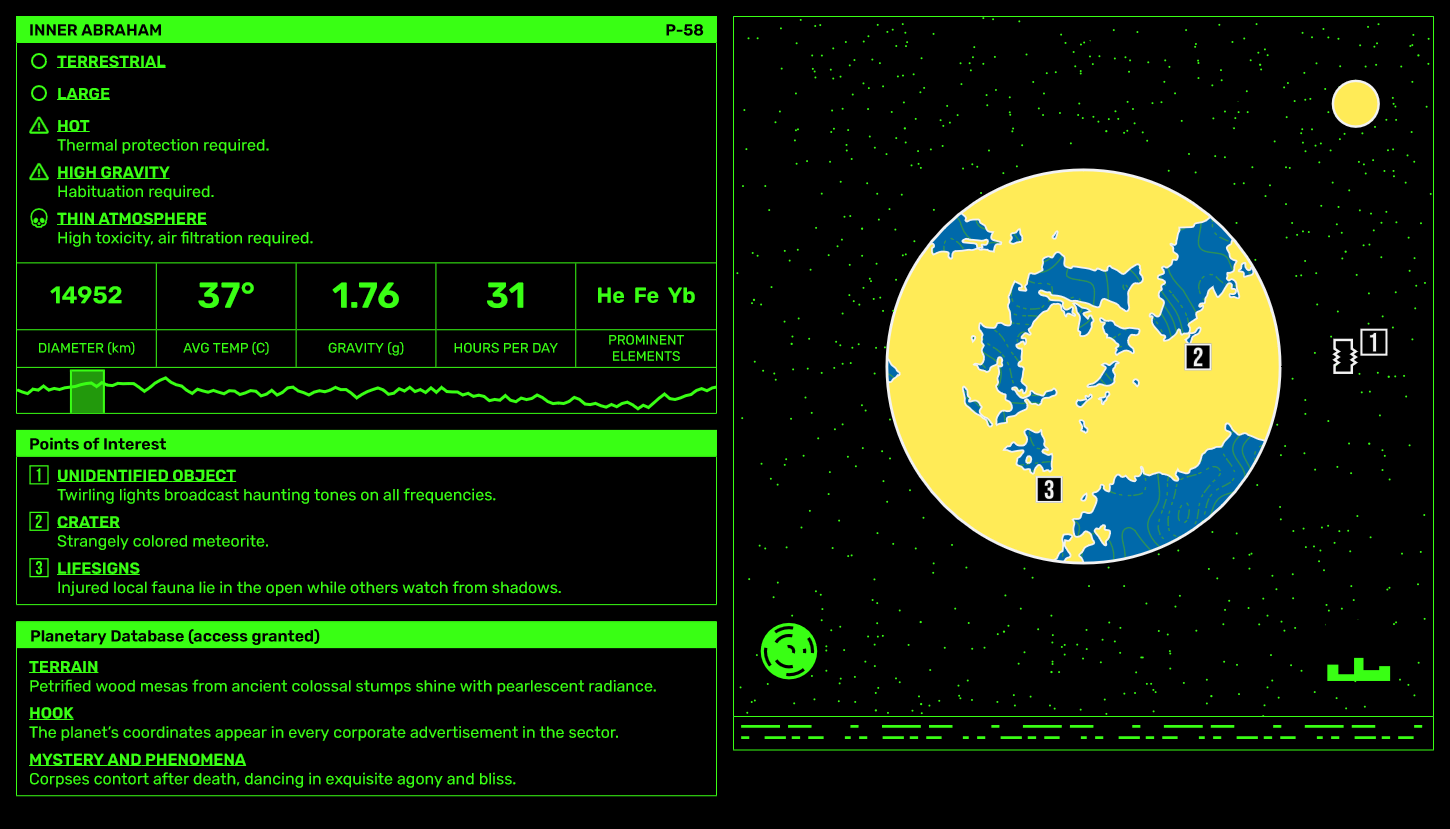
MOSH: Inner Abraham


Playing around with the Rimspace Planet Generator

ABRAHAM SYSTEM, ARARAT SECTOR

Three planets: Inner, Outer, and Inmost.

Outer Abraham is an enormous, poorly tempered but typical superjovian. Inmost Abraham is similarly typical and unsuited for colonization, its sun-kissing orbit boiling its atmosphere away. Inner Abraham is the anomaly - a life-bearing terrestrial world that survived the gravitational chaos that expelled all the other major bodies from the system.

  • Planet Type: Terrestrial
  • Diameter: 14952 km (Large)
  • Average Temperature: 37 C (Thermal protection required)
  • Gravity: 1.76 G (High gravity habituation required)
  • Atmosphere: Thin, toxic. (Air filtration required)
  • Hours Per Day: 31
  • Prominent Elements: Helium, Iron, Yttrbium


Points of Interest


1: Unidentified Object

Twirling lights broadcast haunting tones on all frequencies


Caught in a long, highly-inclined elliptical orbit around Inner Abraham. Moves extremely fast. Extremely radioactive. The tones do not repeat or loop, and the object doesn't respond to any hailing transmissions. The blurry photographs and grainy video don't allow one to make out its shape.


2: Crater

Strangely-colored meteorite


The impact is recent - wind, water, and root have yet to erode the site. The meteorite itself is anomalously intact, and of a shimmering, opalescent quality. Radioactive. Traces of exotic elements in surrounding region.


3: Lifesigns

Injured local fauna lie in the open while others watch from the shadows


The grassland's dominant predator of the grasslands uses the distress cries of its prey - the old, sick, or juvenile - to lure others of the herd into ambush.


TRISKELE

2(20) C:40 I:30


Three-legged. Eyeless, narrow head. Clicking and hissing echolocation. Chitin plating.

  • Serrated Tongue 2d10 - Body save vs bleeding
  • Pack Hunt - Never fewer than 3, never more than 8.
  • Echolocation - As motion tracker
  • Mimicry - Voices, but not words. Moans, shouts, cries of pain. It learns fast.


Planetary Database


1: Terrain

Petrified wood mesas from ancient colossal stumps shine with pearlescent radiance


The trees are not so large as the initial reports indicate, but indeed there are entire petrified forests on Inner Abraham, looming over the lower brush with bare, milk-bone branches. No doubt someone would try to make jewelry or sculpture out of it, and surely it would sell.


2: Hook

The planet's coordinates appear in every corporate advertisement in the sector.


Recent legislation has established that advertisements for colonization must include externally-verifiable locational data, after Doux Interstellar was sued into oblivion for offering debt-reduction in exchange for moving to colonies that didn't exist.


Inner Abraham has not garnered enough attention for the rightsholders to invest in a colony.


3: Mystery and Phenomena

Corpses contort after death, dancing in exquisite agony and bliss


Something with the bacteria, perhaps. Something that triggers spasm in the muscles. Surely it's the bacteria. Just local microbes. Has to be.

Thursday, May 4, 2023

Dan Plays Video Games, Part 2

Been a long while since I have done one of these. My year-end posts tend to accumulate them, so Citizen Sleeper, Pentiment, Signalis, Dwarf Fortress, Vampire Survivors, Tunic, and Rogue Legacy 2 have all been covered elsewhere.

Warframe

Every year to eighteen months I get the itch to go back, and when I was between jobs last year I got the itch. Then I realized how awful the drop rates for necramech parts are on those vault raids and that killed my enthusiasm really quickly. What a fucking grind. 


Sundered

An okay metroidvania, which unfortunately just isn't enough in such a crowded field. Low enemy variety and repetitive combat make for an experience that loses steam pretty quickly. It does look very nice, which is a point in its favor (I do love a good cell animation style), but it has trouble sustaining itself. A big upgrade tree where most of the features are incremental number boosts.


Roadwarden

This is an extremely OSR point and click adventure game. Simple mechanically but complex in content, with a rich setting, good writing, and atmospheric music. Lots of nifty things to swipe for games (riding lizards, goblins are a type of ape, mists that cause undeath) Simple but consistent graphics get the stage set and let your imagination do the rest. The kind of game it's worth keeping notes for. 


Spiritfarer

At its best, its a thoughtful, heartfelt, beautiful game that deals with death with a care and empathy rarely seen in the medium. The art direction is great, so is the music, and when the flow gets going you can lose yourself on the sea of the afterlife.


Unfortunately, all of that good is attached to a lumpy, tiresome, grind-based gameplay loop. In order to get to those great moments, you need X. But in order to get X you need Y and Z, and to get Y you need A, B, and Q, and you don't even know where the hell to start looking for Z. It turns itself into a chore list with a lot of dead time, and that's a great shame. A bit of tweaking of where resources are located, a map you can open at any time instead of just the map room, a better way of organizing your to-do list, and some means of helping you find which of the identical shades are quest important, that would all be improvements.


Sometimes the loop works all right, sometimes gears churn into place and you can make progress, but the early game and mid game slumps are rough.


Vigil: The Longest Night

Sometimes you just know a game's not going to work out, just from the way movement and jumping and the basic combat feels. Refunded this after half an hour and bought Blasphemous instead.


Blasphemous

Gorgeous game, amazing soundtrack, plays like a dream. Lot of stuff to dig into underneath the hood with all the different spells, rosary beads, sword hearts and whatnot. And then there's the Vibes - impeccable. You arrive in the village of Albero and meet the Brotherhood of the Kissers of Wounds and that is such a specific, obtuse, weird, and very Catholic idea that it can only be the result of people who Get It, which the devs do, what with making the entire game about Spanish folk Catholicism on steroids. It's good shit, play it if you haven't, the sequel's out later this summer and my timing was perfect.


Chained Echoes

If you like JRPGs at all, pick this up. "Love letter to X" is a cliche in review circles but this time I think it qualifies. It's made by mostly one guy who not only loves JRPGs, but knows exactly why people love them. There's great pixel art, good music, some webs of connected subsystems to play with, lots of quality of life and anti-frustration measures, solid writing, fun jokes, interesting world that's flavorful but light, and pacing like you wouldn't believe. Starts you off swift and keeps things going, not too fast not too slow. No grinding for experience (you level up from beating bosses), trash mobs give you items to sell (which gives you money and unlocks special items at merchants), the bounty board gives you upgrade items and skill boosts, on and on.


It's the sort of game where, after you finish Act 1 about twelve hours in, the game goes "Well that was fun. Let's expand the scope and add more stuff. Would you like to see how the mech combat works?"

Tuesday, April 11, 2023

Pocket Mononoke Cipher

A rather silly thought that occurred to me, in the vein of Semiotic Unstandard: orchestrating secretive / clandestine missions against the weird and unknown through the smokescreen of a Pokémon role-playing forum. Handlers are gym leaders; agents are their teams of individual Pokémon. Leadership are the Elite 4 and Champion. Different regions or specific gym leaders might mean something, I didn't think that far ahead.

Threat information is encoded in 'incoming challenger' character profiles. The first Pokémon on the team (or the first type, if they are dual-typed) will indicate the primary nature of the threat, with subsequent types and clusters thereof acting as additional information. Additional variables are denoted by the trainer class

With the amount of material available, I'm certain you can get very, very granular and specific if you want to. Known threats would likely have their own three-pokemon combos that are read differently from the normal threat cipher (Cthulu as Tentacruel-Dragonite-Drowzee?) but this, I think, is a fine-enough sketch to start with.

Threat Information

  1. Normal - Placeholder; used to break up groups of traits
  2. Grass - Biological threat
  3. Fire - Active / ongoing threat
  4. Water - Biological threat (aquatic)
  5. Flying - Mobile & uncontained
  6. Electric - Phenomenological anomaly
  7. Fighting - Human threat
  8. Rock - Threat item
  9. Ground - Threat area
  10. Bug - High or increasing number / severity
  11. Poison - Pathogen or infection
  12. Psychic - Consciousness alteration / memetic threat
  13. Ghost - Non-material entity
  14. Ice - Threat is currently stable but liable to go hot
  15. Dark - Threat unknown, proceed with caution; other type markers are conjecture if paired
  16. Steel - Technological threat
  17. Fairy - Confusingly looks like something else; Fuck this in particular
  18. Dragon - Major threat; immediate action required
  19. Egg - No threat yet; observe to determine risk
  20. Glitch - FUCK


Additional Information

  1. Youngster / Lass - Baseline; no special circumstances
  2. Bug Catcher - Capture target if possible
  3. Ace Trainer - Agent already in field
  4. Twins - Double cell deployment
  5. Psychic - Enemy sorcerer
  6. Sailor - International travel
  7. Rocket Grunt - Undercover (organized crime)
  8. Hiker - Wilderness travel  
  9. Gentleman - Rich bastard alert
  10. Biker - Long distance, in-country travel
  11. Engineer - Urban environment
  12. Expert - High difficulty
  13. Pokemaniac - We actually have good intel this time.
  14. Hex Maniac - Cult Shit (TM)
  15. Ruin Maniac - Deep Time Mysteries (TM)
  16. Beauty - Person-of-Interest
  17. Dragon Tamer - One (1) bailout is available.
  18. Parasol Lady - Shitstorm forecasted.
  19. Blackbelt - Combat mission or raid.
  20. Officer - Police on the take.

Sunday, April 2, 2023

Conlang Sketchbook 2: Paracelsan Noun Endings

 Previous Notebooks: 1

Introductory Paracelsan Noun Endings

This was originally inspired by a bad conlang prompt (a riff on the AtLA opening), but I am one of those people who work best with shitposts played sincerely and it has since turned into something well beyond the original prompt.

It's intended for some sort of Greco-Latin-ish one. Fitting for something made by wizards.


Prior posts (well, post) in this series can be found here.


Anyway, noun classes! There are quite a few of them in Paracelsan.


Elemental Classes

  • Water - Liquids, aquatic animals, concepts that are malleable and adaptable
  • Earth - Inanimate objects, plants, land animals, rocks, metals, concepts slow to change
  • Fire - Fire, lightning, humans, concepts that are dangerous or high-energy
  • Air - Flying animals, weather, concepts that are free and open ended


Planetary Classes

  • Mercurial - Swift things, small things, transportation, communication, commerce, trickery
  • Venusian - Beauty, love (romantic), lust, passions; art (high)
  • Terran (1) - Systems consisting of many Elemental-Class components; Love (nonromantic); art (common)
  • Martian - Conflict, violence, anger; body parts
  • Jovian - Worldly powers; law, authority, religion, politics
  • Saturnian - Terrors and horrors; monsters, omens; mysteries and the unknown


Divine Classes

  • Solar - The divine of the absolute, unchanging, overwhelming.
  • Lunar - The divine of transformation, change, and subtlety.
  • Terran (2) - The human component of the divine.
  • Stellar - The numinous, transcendent divine.


Appropriate for an alchemist's language, nouns can change their class from their usual default to reflect a certain context, the intention or belief of the speaker, or for greater specificity. (I seem to really like this idea, huh. Used it in the last post too). Some examples:


  • "Animal" might be air, earth, or water depending on habitat, or fire if you're talking about lunch.
  • Humans tend to default to earth, but could be any of the other three depending on what the speaker is trying to say about them.
  • Actions would vary depending on how they are carried out - to act carefully would be an earth ending, to act rashly a fire one.
  • "Stone" could be given air endings, if you wanted to emphasize that it was flying through the air at high velocity.
  • Gasoline, battery acid, and alcohol, while liquids, would more likely than not be fire class.
  • Jovian nouns can often be turned into Saturnian
  • Artworks can switch between Venusian or Terran depending on where and when they are popular, and with whom

As for the classes themselves, here's the handy tables. I don't like most of the results of the planetary and divine classes, as I had run out of good examples from real-world languages to use and the draft was taking up space. For reasons of not getting stuck forever on the thing, only elemental classes have inflected plurals.


|-----|------Water------|---Earth----|----Fire-----|----- Air---- |

|-----|-----------------|------------|-------------|--------------|

| NOM |-qua / -quas     |-os / -oi   |-e / -es     |-ia / -i      |

| GEN |-quae / -quaes   |-ou / -ous  |-is / -ies   |-ai / -ais    |

| DAT |-quia / -quias   |-or / -oros |-ire / -iren |-iri / -irais |

| ACC |-quiam / -quamas |-on / -onoi |-en / -emas  |-ian / -iani  |

| LOC |-quava / -quavas |-o / -ous   |-eva / -eras |-avi / -avais |


|-----|  MRC  |  VEN |  TRN   |  MRS |  JVE  | STR    |

|-----|-------|------|--------|------|-------|--------|

| NOM | -ek   | -nna | -dun   | -rum | -aal  | -khat  |

| GEN | -en   | -mmu | -thana | -im  | -vuun | -qal   |

| DAT | -ei   | -lle | -eth   | -gho | -sh   | -mugan |

| ACC | -ak   | -nta | -ahla  | -sir | -maa  | -vokh  |

| LOC | -etan | -ssa | -du    | -zor | -doo  | -ze    |


|-----| SLR  | LNR   | STL  |

|-----|------|-------|------|

| NOM | -rya | -sej  | -ain |

| GEN | -n   | -ele  | -la  |

| DAT | -paq | -yen  | -e   |

| ACC | -kta | -iala | -am  |

| LOC | -pi  | -mine | -i   |


Part of me wants to do something with verbs and the steps of generating the philosopher's stone, but that is perhaps for another day.

Goes without saying that if this spurs any other absolute madren out there to write something, I would love to see it.

Thursday, March 16, 2023

Some Thoughts About Language in RPGs

In my conlang dabbling, I have thought to myself "self, what about just a very simple naming language for use in RPGs for a bit of inspiration and flavor?"

Well, that project hasn't gotten off the ground and is also for a very niche audience (this is my niche, it was made for me!). But I remain on the linguistics kick and have been thinking of more practical ways of using it in games. This post will entail two of them. Several other people have written about this subject already (including me), and I assure you I will write about it again.
 

Scripts and Ciphers


The principle is simple: you use a non-Latin script as a cipher for English. The cipher represents an in-game language unknown to the characters, and a players learning to decode the script is representative of their character learning the language.

You can make up your own if you so feel like it, but there are also plenty of scripts out there to choose from, both actual and artistic. Omniglot is your friend here, especially the pages for alternate methods of writing English and scripts for conlangs. Quality varies significantly, but there is sufficient quantity to make that a non-issue. Top posts on r/neography will likely do good for you as well.

In practice, I would recommend mixing up the presentation if you are using multiple languages. Cipher other languages that would be relatively easy for players to decipher (Latin would be the obvious choice, but depending on your players this can get a lot more complex). Cut up or recombine words. Spell things phonetically, or use different romanization (ex: x for sh, j for y). Use single letters to represent entire consonant clusters or dipthongs. Use a script with phonemes that don't match up exactly with those of English and get creative. Remove vowels. Remove spaces. Apply a ROT13 or other cipher to the original text before changing the script. Or just limit yourself to one script - it worked for Tunic.

Or just ignore all that and use them purely for handout flavor. Playing a dwarf? Your character sheet has X script on it. This is probably the easiest method.

Some favorites of mine, in no particular order, chosen mostly according to raw aesthetic appeal.

  • Mkhedruli - It's like Tengwar but real. 10/10, no notes.
  • Glagolitic - The Witcher uses this script, and for good reason - another one with primo aesthetics
  • Deseret - This alphabet is actually terrible, but that does work in its benefit as a cipher - it's got loads of similar-looking letters and false friends with Latin characters, which can make for a good puzzle.
  • Shavian - I can't figure out if this is ugly and unreadable or tightly designed and slick. Whatever. It's an option, and it's here.
  • Ditema-tsa-dinoko - The languages this script was designed for don't have a particularly large phonetic overlap with English, so if you use it you'll either need to add characters, or change a lot of consonants. But as is a recurring theme here, it looks fantastic, especially if used in the combined / colorful forms.
  • Canadian Aboriginal Syballics - Another script that doesn't have a lot of English overlap (though Omniglot does feature a variant someone made to that end). Also, I think they are extremely cool and more people should know about them in general.
  • Sitelen Sitelen - The fancy version of writing Toki Pona. Logographic, so you will be stuck using Toki Pona's minimalist wordlist and lack of grammar unless you decide to mix it in with other scripts (it would make for a very good cartouche system, honestly, especially with this handy vector renderer)
  • Zbaeleroma - Originally designed for Lojban. Decent aesthetics, won't be too complicated to crack (especially if players know voiced / unvoiced consonant pairs)
  • Ithkuil 4 - Now, using the full version would be highly impractical, but there's a simplified version down at the bottom of the page that's a normal abugida. I think this is a really good option, honestly: the phonology has significant overlap with English, and it's obscure enough wrt how vowels and consonant clusters are written that it should prove a not-too-difficult challenge.
  • Tunic runes - If your players haven't played Tunic, there's no reason not to use it. It works!
  • Heaven's Vault script - Like Sitelen Sitelen above, this one will require a bit of additional effort, as its connected to an oligosynthetic language and you'll have to bolt together conceptual characters into words of any sort of complexity. But it is beautiful, and there is a considerable pre-existing corpus of those complex words, thanks to the game being all about translation.
  • Warframe scripts - The game's got five of them (Orokin, Grineer, Corpus, Solaris, and Ostron) in varying levels of complexity and readability, all with different vibes. Personally I like Ostron and Corpus best.
  • Hallownest Script - It's Just Really Neat.
  • Aurebesh variants - While the baseline script is a simple 1:1 English cipher and I don't think it looks all that good, with a little creative orthography and one of these variant fonts you can get something pretty cool out of it.
  • Hylian Scripts - Pretty recognizable, but decent options to keep in the back pocket.
  • Blissom's English Syllabary - For when you want to look like katakana. I like this one quite a lot.

Bonus: Rapid-Fire Omniglot Selections
Curvetic; Heptal; Reality; Tennent; Westonian; Oxidilogi


The Languages of Generic Vernacular Fantasyland


This is not particularly practical, but it is at least a bit of additional flavor that can be used for your Generic Vernacular Fantasy Land.

Commonplace Languages

Being those that a human being can speak without magical means.

Elvish - An incredibly difficult language to learn - in great part for an inventory heavy in sounds considered rare in human languages, but even more so because the written language fossilized millennia ago, sound change has been moving along ever since, and the overall conservative current in elvish society has sunk every proposed attempt at spelling reform.

  • Features: Triconsonantal roots; tones; uvular series; retroflex series; click consonants; whistle components; pure abjad.


Dwarfish - Central to the dwarvish languages (and adopted by many languages of neighboring humans) is a logographic script carefully regulated by the centralized stonecarver councils of the Mountainhomes. As the meanings of characters remain the same (this is easier to accomplish with a dwarven mindset, less so with humans) they allow for easy transfer of information between unrelated and incompatible languages, and thus have become the adopted standard in nearly all dwarven civilizations.

  • Features: Analytic; isolating; tap-code register (domesticated knockers are used to send long-distance; high speed messages down in the caves); numerical forms used for high-density communication


Halfling - A limited phonology and restrictive syllable structure mean homophones are common, puns are rampant, and transcription into other writing systems is extremely difficult. 

  • Features: Extensive noun-class system, unique script, plain/aspirated/ejective distinction, ergative-absolutive alignment. Highly adaptable derivation of obscene terms. Let's hear it for tɬ!


Martian - There are technically three Martian language families - the most widely known off of Mars (and to non-Martians) is that of the now-liberated Red Martian underclass.

  • Features: Prenasalized stops; broad/slender (velarized/palatized) consonant distinction; sandhi; ye gods those are some large consonant clusters; phonemic vowel length; perfect direction; beautiful calligraphic script.


Orc - An experiment by sorcerers to enforce hard Sapir-Worf Hypothesis on their soldier-slave legions. Thankfully, hard Sapir-Worf is bullshit, and so in the wake of the overthrow of the Dark Lords, orcs have taken on some very creative strategies to overcome the artificial limitations of their original language. While loan words are often adapted from neighboring languages, more popular by far is making creative compounds out of the existing orcish lexicon.

  • Features: Internally-developed abugida recently adopted; artificially regular grammar and limited vocabulary; measure words; robust neologism formation; frequent loanword adoption; complex system of formal address dismantled and repurposed.


Common - There are four different languages called "the common tongue".

  • Imperial A - The language of the previous empire to rule the region; serves as a shared second language among both those once ruled by Empire A and those on the outside who wished to interact with it. Mildly synthetic, polypersonal agreement, grammatical gender, robust derivation system allows for easy formation of new words. Dialectic diversity will eventually lead to formation of separate languages.
  • Imperial B - The language of the current empire. The standard for politics, magecraft, military matters and sanctioned religions. Not commonly used by the underclasses (save in rebellious territories, where standard practice is total replacement of indigenous languages through imperial schooling). Highly agglutinative, irregular verb morphology, vowel harmony system, a couple leftover laryngeals in the phonology.
  • Free Peoples - A trade language of peoples bordering the empire. Simple phonology with (mostly) strict CV syllable structure, nasal vowel series, and I sure hope you like verbs because we've got some beautiful polysynthesis going on here. Extensive tense-aspect-mood morphology.
  • Friend-Sign - The most widespread and useful of common languages, as it is signable by any being with at least two arms and four fingers (regardless of their mouth and throat structure). A written version later emerged, representing the positions and movements of the most common elements of the signed form, and has since become equally widespread and useful.


Uncommon Languages

Being those that require some manner of magical assistance to speak or comprehend.

Ghoul - Vocal components often described as consisting of "gibbering", "yipping", "howling", "meeping", "keening" and "snuffling". Heavily dependent on scent to carry additional information; humans both lack the ability to detect the meaning-shades imparted by these scent-markers, and are repulsed by the use of rotting flesh, skin oils, urine, and fecal matter as components of grammar. Ghouls' vocal mimicry permits them to speak human languages, but makes communication no less unpleasant to those human participants.

Deep One - The extreme physiological variety between icthropai lineages means that their languages trend towards mutual unintelligibility. Despite this, there are some common elements shared (often in conjunction with each other) among them: ultrasonic whistles and clicks, carapace / mandible / claw scraping, pressure bubbles, modulated electric currents, and color change. Communication between lineages and with humans will need either specially-engineered translator hybrids or direct use of magic.  

Giant - The languages of the giants are heard by humans only as a deep, distant rumbling, as if a train is passing by. Their immense size (and thus, the immense size of their vocal cords) render their speech so deep that most of it exists in the infrasonic, well outside of the human hearing range. Their unique chambered respiratory systems (a necessity in getting sufficient oxygen) permit them to inhale and exhale simultaneously and without ceasing, as if playing the bagpipes.

Dragon - Imagine being able to remember that you once knew the song of the sun, but not able to remember the notes. That is what it is like to be a dragon - to be aware that you are becoming more and more like an animal with each passing season and, unable to stop it, losing that awareness until there is nothing left.

Aboleth (Benthic) - The ordovician masters communicate mind-to-mind, through direct transferal of their trench-deep thought. If an aboleth ever needs to speak to a non-aboleth, it will simply tear the language-knowledge out of the victim's mind, re-assemble it in the necessary order, and play it back in the victim's own voice.

Goblin - Gobbledegoblin is the linguistic form of Calvinball - perpetually in flux and hewing to no rules longer than what's considered entertaining. It's a funhouse mirror of the listener's native language, mocking prescriptivism and propriety with purposefully "incorrect" usage and absurd traits (noun classes based on species of freshwater fish, armpit-fart tone systems, common words get their meanings radically changed, so on and so forth). It is more of a language game than a language itself, which is fitting for goblins.

Lithic - Delicate organs of vibrating crystal; clusters of silicate chimes; wind howling through funnels of sculpted stone. A few of the lithic ambassadors can use these features to imitate human languages; a skilled occultist will be required as an intermediary otherwise. There are theories that these features are either mostly ornamental or engineered specifically for human benefit, and that lithics an home in the upper mantle instead communicate through controlled release of radioactive material.

Imperial Elder - The pentatone musical language used by the Elder Empire is an echo of the flautists of the azothic court of MANA-YOOD-SUSHAI and the drumming of great Skarl. Whether it was purposeful imitation, coincidence, or the result of some sensitivity to the Dreamer and its attendants is unknown, and perhaps never known to begin with. The written form (recovered in a vast corpus from the Antarctic capital city) is a direct graphical depiction of Elder mouthparts and the appropriate tones for each note-concept - while incredibly complex to learn and impossible to speak without aid, machine translation has made impressive advances towards translation.  

Imperial Shoggoth Interface Language - A code of chemical signals and truncated musical tones, used to give commands to the amorphous beings. While the hated enslavers are long dead, hard-coded recognition of the Interface Language remains in the mainline descendant clades. The Polyps and Dark Young carved this knowledge out of themselvesmillions of years ago.

Yuggothic - A combination of bioluminescence, mycelium-ferried electro-chemical signals, chitin-clicks, and hyperspatial ripples. Undeciphered; even those who are host to symbiotic strains of the yuggothic mega-organisms are incapable of describing how any of the components correlate to discrete information.

Mi-Go Machine Interface Language
- Undeciphered coding language used in the brain-interfaces of human-compatible Mi-Go hard-tech.

Yithian - We only have knowledge of the scribal shorthand script through the tablets recovered from the Pnakotic ruins, but this has proven enough to serve as a (slow, incomplete) means of deciphering other texts found within the library.

Carcosan - [THRONE DECREE 6511-45 - ANY PERSONS FOUND TO SPEAK THE LANGUAGE REFERRED TO BY SAFEGUARD EUPHEMISM 'SAFFRON' WILL BE SENTENCED TO DEATH ALONGSIDE ALL KIN WITHIN FIVE DEGREES OF RELATION]

Last are the languages that I didn't get around to writing meaningful blurbs for but wanted to mention for completion's sake: Kobold, Cynocephalic, Akeloi, Drow, Derro, Cetacean, Octopode, Corvid, Ape Sign, Elephantine, Alignment Languages, Class Languages