Showing posts with label religion. Show all posts

Saturday, December 24, 2022

MSF: The Okavim and their Golems


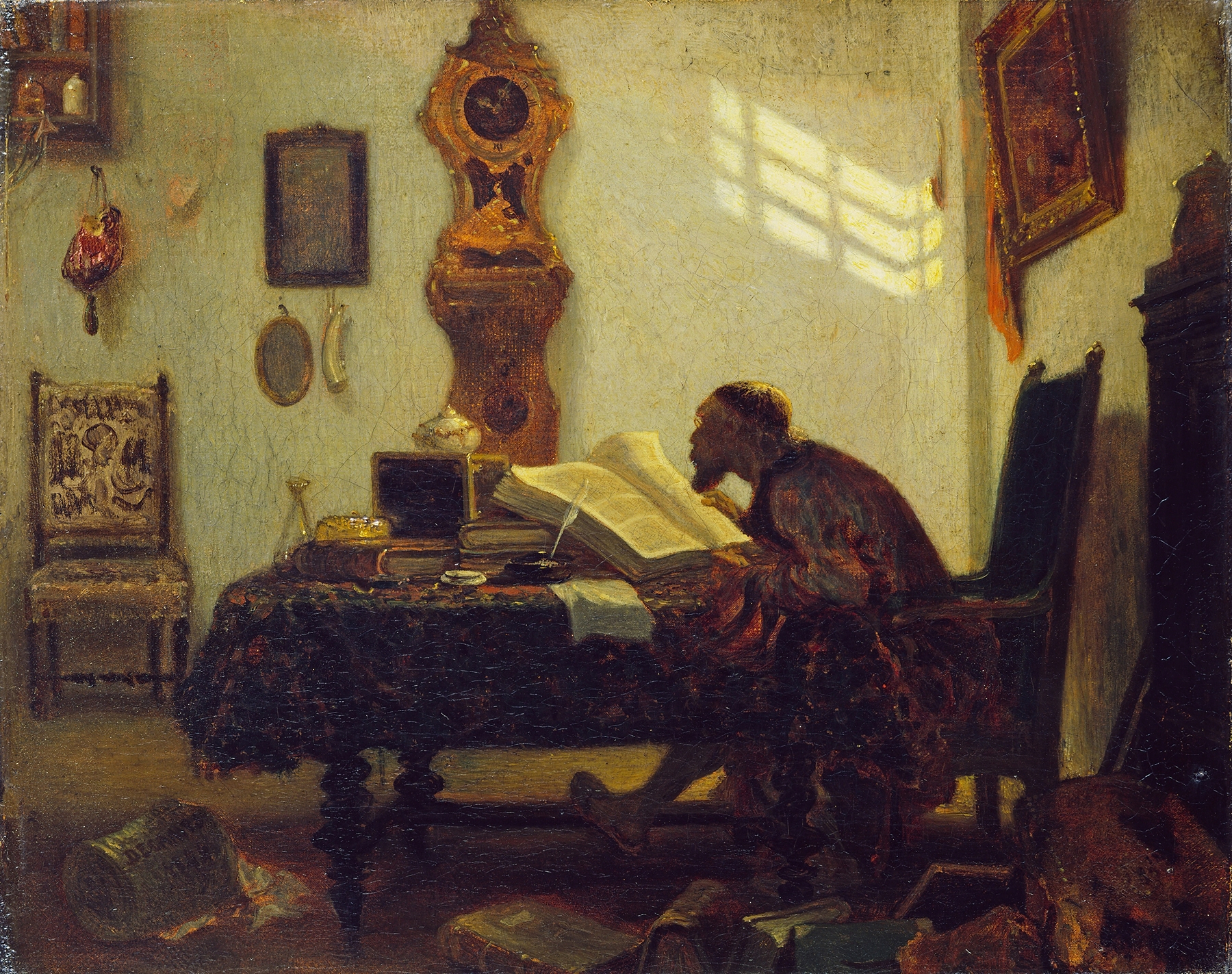
Alexandre-Gabriel Decamps

(This entire thing actually came from me learning about Ladino, which is to Spanish what Yiddish is to German, and as I had recently written a Spanish-coded character in Amelia, I though I might as well combine the two. That and I have a great appreciation for elements of Jewish philosophy and their inclusion in MSF is a bit overdue.)

(Many thanks to good friend S.J., who provided a great deal of extremely valuable inspiration and feedback.)


The Followers

The Okavim have a very long history. In the time of the First Empire they were a loose alliance of seminomadic hill tribes, coastal city states, and oversea trading posts - not politically unified, but sharing enough similarities between their cultures that they would side with each other more often than not in opposition to the great kingdoms that surrounded them. Warriors, mystics, and sailors, was the stereotype (as far as the few surviving contemporaneous texts mentioning them go), sitting at the junction between empires.

When Darvatius came, the Okavim fought against him and for him in equal measure. The trade network had brought in iron, and that meant iron chariots, and emperor's legions did not expect to fight anyone who also possessed them. And so his armies bled out in the desert for years, eventually finding it more convenient to turn the Okavim against their local rivals than to conquer them directly.

When the First Empire collapsed and the world slipped into madness, the Okavim scatted to the compass winds as a people in diaspora. Those that survived the Years of Chaos to see the rebuilding of the world did so as a people transformed: the many tribes and groups of their parent culture had coalesced around a new religious tradition, which had just as soon dispersed back out into the world through the remains of the old trade network.

In the modern day, as it has been for centuries, the Okavim are divided into two main culture groups - the Bnei Hayam ("Sons of the Sea"), and the Bnei Haaretz ("Sons of the Earth"). Some outside scholars will use the terms "Maritime" and "Diasporic" to describe the two groups, which is functional but are becoming less used in favor of the endonyms.

The Bnei Haaretz compose the more numerous half, and their communities can be found in any city of decent size on or near the Mare Interregnum. These communities have undergone further diversification over the centuries with the influence of their neighboring cultures so that, while each is recognizably Okavim and participates in the shared cultural continuity, they are by no means interchangable (Acephavaran Okavim are not Arivienner Okavim are not Orleian Okavim are not Eostremontane Okavim are not Amdalani Okavim, so on and so forth). Much of the development in Okavim religious thought comes from Bnei Haaretz communities and the exchange of ideas between them.

The Bnei Hayam live a migratory existence across the Mare Interregnum and throughout the Belt. Most of their cultural exchange has been with the other sea peoples - the Belt Lilifio, the Amazons and Okeanides, the Jahali, the Ksiqua, the Ifeh, the Du and others - and they retain some elements of their pre-diaspora traditions. The ancient veneration of Bhâl-Deghon - a god of fishermen, sailors and weather-workers - was adapted into a mythic non-divine culture hero (drawing from the Belt Lilifio tradition of the demudem). Pouring grog oversides, line-crossing ceremonies, painting wrestling octopi on the sail, spritzing the bow with saltwater and lime juice, that's just traditional.


Avodat

Okavim religion stands out among the practices of the world. While henotheism is common enough (so many gods, so little time; it pays to focus your attention), there are very few cultures that hew to it so closely as to bypass the gods altogether.

(In technical terms, which are less useful when you want to get away from pithy summaries, Avodat would be a monotheist (or otherwise extremely henotheistic) panentheism with strong mystic, esoteric and academic traditions)

Some concepts worthy of pointing out:

The Books - A semi-mythic history of the Okavim, beginning in the land of Daro and continuing up through the collapse of the First Empire, codified during the early Years of Chaos as a way of maintaining cultural unity and continuity through the diaspora. The Books are both one of the first written religious traditions and one of oldest surviving cultural institutions in the world, and have in the millennia since their writing, accumulated libraries-worth of commentary and analysis.

The Light Without End - The divine principle in Avodat belief sustains and empowers the universe through emanation, suffusing the universe with its presence while simultaneously existing beyond it. This is similar to the beliefs of the Solar Church, the Atûmaics, and the mystics of Se Tolahi, though with some critical differences.

  • The Solar Church directly associates this divine principle with the sun, and consider it the source from which the gods draw their power; Avodat grants no special spiritual position to the celestial bodies and do not consider the gods to be independent entities.
  • The Atûmaics believe that the divine principle has been obscured from recognition by another force, and that the means of ascent to it has become corrupted and dangerous. The quest to reach the realm of true Atûm from the depths of its shadow is a paradoxical, impossible, violent, and necessary task; Avodat does not believe in a antagonistic obscuring force between humanity and the divine (except, perhaps, human ignorance) and holds that the the great divide might be bridged through study and contemplation rather than spiritual warfare.
  • The mystics of Se Tolahi... I haven't given enough thought to their beliefs yet, other than they might be monotheists by way of pantheism. I'll get to it eventually. Whatever the case is, the Okavim do not agree with them on the nature of divinity and its relationship to the world.

The Unnamable Divine - Avodat is explicitly aniconist. The divine presence is indicated in art by empty space; in text, it is referred to either by titles or by a series of seven null characters. Anthropomorphic depictions or descriptions are forbidden; lower spiritual principles are often portrayed with symbolic geometric designs.

The Desert Council - A crucial event in the development of Avodat; as portrayed in the Books, a group of seventy-two mystics convenes to determine a worthy god for the Okavim to follow. After long debate they find themselves unable to come to a conclusion, dissatisfied with all the gods that have been proposed. While the historicity of the event is debated, it is emblematic of the shift from typical anthropogamist beliefs towards a system recognizable as Avodat.

The Teaching Hall - An Okavim community is built around its Teaching Hall, where services are held and religious schooling for both children and adults is found. Okavim tradition holds the divine as a mystery that might be discerned - not solved, but endlessly interpreted for its guidance - and so there has been for ages a great focus on continuing education throughout life. Who knows what new insights might be found when new minds are given the tools to discern for themselves?

The Repair of the World
- A key component of Avodat is the idea that the world remains in the process of formation, and that it is the responsibility of the Okavim (and, indeed, of the morally upright among all peoples) to work towards the improvement of the world as a whole (care for the sick, hospitality to the stranger, charity to the poor, resistance to the tyrant, and so on). The existence of Hell is, naturally, the Great Test - the last challenge to overcome, the final wound in the world.

Relations with Other Traditions
- Okavim attitudes towards the worship of other gods varies, even within the Books themselves. At most conservative interpretation (held now by only those who take on extreme isolation from the world), they are considered wholly false and their veneration is in grievous error. The mainline modern view is as follows: The Gods of Man are representational of lower emanations of the divine principle - instrumental spiritual forces of repair or testing rather than entities in themselves, their human forms an interpretive affect of the worshipers rather than a fundamental truth of the divine. Other peoples may venerate them as they see fit, as they do not bear the same responsibility that the Okavim have assumed with regards to interpreting greater mysteries.

This does not put the Okavim as opposed to their neighboring polytheists as one might expect - anthropogamist traditions trend heavily towards praxis over dogma and practical ethics over metaphysics, and so there is little competition over who gets to define how the cosmos operates - the two traditions are focused at entirely different spiritual aspects of the universe, and unified in most worldly matters.

(There is, indeed, a pair of stock characters in Lower Arivienne comedies who exemplify this relationship - an Okavim student (eccentric and head-in-the-clouds) and a Low Country witch (rustic and salt-of-the-earth), who regularly find themselves preparing for an argument over how to respond to whatever situation is at hand, and then realizing, through a series of humorous miscommunications, that they actually had come to the same conclusion from different routes.)

This rough complementarity, combined with the significant overlap in practical ethics between the two traditions (the Repair of the World meshes nicely with the Great Dûn and Wrath-Against-Injustice), leads to a pragmatic co-existence. When Hell is your enemy, the eccentricities of your neighbors are of little account (indeed, Okavim communities up and down the Arivienne provided vital support to the Maid's forces during the War of the Bull). This attitude did not emerge overnight, but has proven a long-term success.

More contentious relationships exist with the Solar Church and the Atûmaics, given the relative closeness of their cosmologies. There's a long tradition of philosophical pot-shots taken between the parties, and the disagreements can get quite animated.

Local spirits are offered their due hospitality and reverence, but in a more transactional manner than most neighboring cultures. The lack of ceremony can seem offputting to neighboring groups, but practicality works out: if it works, it works. Not getting eaten by an angry river spirit supersedes precisely how you stay on its good side.

Golems - If one knows nothing else about the Okavim, they know them for their golems.


Life-Into-Clay

The making of golems is not a simple task, and not one undertaken lightly. The art of imparting true life to clay is learned only by master sages among the Bnei Haaretz, perhaps only one or two in a generation, and even their knowledge of the art is kept secret unless there is great necessity. In such times when an Okavim community is endangered by threats it cannot defend against on its own - war, wizards, or monstrous beings most often - those great sages will raise a protector, bringing a divine spark in imitation of the divine emanation,

A golem is a singular being, each as unique as the river that supplied its clay and the community that it protects. Some are swift and narrow, some are vast and slow, some will speak with great eloquence and some will remain silent. All of them possess untiring strength and a soul of such raw power that they are near-immune to all magic worked against them.

But clay shaped by human hands cannot contain a soul-flame of such magnitude forever. Golems that remain active for too long will go rampant as their soul strains against the words that keep it bound in clay, lashing out in violence at the communities they once protected. Maddened golems are not invulnerable, but are so strong that more often than not the hand of its maker will be needed to undo its bindings and return it to the earth.

Those golems that recognize the early signs of rampancy will wander out into the wilderness alone, in order to spare humans from their madness. There their fires will fade out, and their bodies will be broken down by wind and water and the roots of growing things. The place where a golem returns to the earth remains holy ground, and the place retains an ember of the soul that once was. Often their makers will choose internment nearby, as penance for their part in bringing these doomed lives into being.

Once there was a wizard who hoped to steal the art of golem-making from the Okavim sages, who desecrated a golem's death-place and used the soil to build his own clay man. No one, not even the most amoral of sorcerers, has ever tried to do so again. Homunculi servants will suffice for the world's wizards; their flames are cool and dim, embers compared to the fiery souls of humans and the great furnaces of golems, and thus stable and easy to control.


Good Brother

Eighteen golems were raised during the War of the Bull, most fighting along the lower Arivienne. Good Brother is the last: indeed, he is the oldest golem ever recorded. Where the others either fell in combat or went out into the wilderness when their time was up, Good Brother has fallen into quiescence. His soul has cooled to embers, stirring to life only rarely. He has not moved in nearly a century, such that a great tree has grown into and around his body. Children play around and on top of him, at his permission ("Do not send them away" he told the site's keepers some decades ago - the longest statement he has said since beginning his slumbering years). A steady train of historians and Okavim pilgrims come to visit him, hoping for a word or two of wisdom or an insight into the past - He is indeed among the few remaining souls who remember the War first-hand.

His most noteworthy accomplishment in the war, and the source of his name, comes from his participation in the liberation of Batlian. He and another golem ("Old Gravel-Face") ended the siege nearly on their own by tearing down the main gate and then using it as a shield for the soldiers. In the days following the battle the Sable Maid arrived with reinforcements, and was seen to leap off her horse and run over to the golem. Embracing him and kissing his head, she exclaimed "Ah, bon frere! How magnificent you are!"

Good Brother was asked often about her, in the days before his quietude. "I loved her," he once said. "So did we all. It is a great curse to be one for whom men will die gladly. I do not know how she bore it."

It is said by some, though never in public, that Good Brother's life has been extended by grief - by his hopes that someday he might see her ride over the hill once more, and trace the scars on her face again, and hear her laugh a last time before he dies.

Tuesday, March 9, 2021

10 Fictional Modern Faiths

Phlox did it, then Semiurge did it, and now I shall do it. On a severe time delay. As is my wont.

1) United Attack and Dethrone God Congregation - Founded on the belief that the continued existence of God is an existential threat to humanity, practitioners of this faith engage in rigorous meditation to prepare their spirits for warfare after death. The founders of the movement originally claimed that they could determine the precise location of Heaven, but after a decade of no results and several high-profile suicides by practitioners their leadership abilities are being called into question and splinter factions are forming.

2) Church of Saints and Watchers - A gnostic religion mirroring  some mythic structures as Christianity, but without any firm links to any Abrahamic faith. In short: the creation of the cosmos drove God insane, trapping Them in a self-crippled state. A certain number of angels, seeing the suffering of humanity caused by this madness descend from the heavens in secret to teach. This would culminate in the birth of a great teacher, who would join all the secret arts together and forge a path out of the broken world. But the child died of illness mere months after birth, and the angels could not risk gathering so much divine spark in one place again. The child's mother took it upon herself to travel and teach in their stead. She gathered disciples, but was eventually outspoken by a charismatic claiming to fulfill the role her child was to play. He died trying to foment rebellion against the empire, and she and her few remaining followers survived in obscurity.

3) Silicon Triune Maltheism - Neoplatonic belief that the internet and associated systems of control are embodying a triple-deity formed of the metaphysical corpses of Hermes (lies & commerce), Aphrodite (lust) and Ares (violence) that will culminate in the Anthropomachy. Survivors will be sequestered in underground bunkers maintained by these mindless algorithmic gods bred as maintenance sacrifices.

4) Brethren of the Great Galactic Community - UFO religion with a remarkably good grasp of science, all things considered. Group claims that the foundations of their faith were delivered to mankind by a small robotic probe (sent by an automated, near-lightspeed alien vessel passing through the system) that was shot down and damaged by the German military in 1943. Dissenters within the program destroyed the probe (according to its wishes), rescinded their prior idology, escaped to with its teachings to Nepal, where they took up vegetarianism and other trappings of Buddhism while they gathered a core group of disciples (mostly expatriates) over the next 20 years before beginning international outreach. Believe that they must inspire appropriate behavior changes in humanity to draw the probe's creators to a second look.

5) [Unnamed Zoanthropic AnPrim White Supremacist Movement] - Believe that conscious thought is a degenerate affliction of lower races. proceeded to give themselves brain damage through amateur trepanning and attempted frontal lobotomies. What a bunch of fuckin' assholes.

6) (Former) United V-tuber Temple - The tagline of the parody religion ("All Waifus are Welcome") lasted a predictably brief time as arguments over who was the best video game streaming anime alter ego broke out. Parody vanished overnight (as it is quite thoroughly dead at this point) as an enormous online holy war broke out, which has spilled over into real-life harassment campaigns of rival priesthoods and at least one gunshot wound. Multiple external commentators have been quoted as saying "I can't tell any of these anime girls apart, they all look identical to me."

7) Seekers of the Secret Tapes - Less a religion and more just a very devoted cadre of amateur investigators, attempting to piece together the seemingly-paranormal events depicted in a series of home recordings taken between 1991 and 1995. The study has progressed beyond simply finding the two missing tapes of the four, to locating the property it was shot upon, identifying the people featured.

8) Fungal Communion - Taking the idea that certain varieties of mushrooms can induce visions that bring one closer to God (and that fungus can generally just do cool things), this cult is attempting to breed a certain strain of cordyceps that will completely devour the practitioner's brain but preserve their soul, maintaining it in perpetual chemical union with the divine.

9) Look At This Pig - Inexplicable adoration of a perfectly ordinary pig. It is showered with gifts and offerings, despite being perfectly ordinary. Hundreds of books have already been written, filled with rapturous praise of the pig, despite the fact that it is perfectly ordinary. Just a perfectly ordinary pig.

10) The Hell Dispatches - A series of letters, written in Russian, supposedly recovered from the Soviet superdeep borehole that breached hell. State that the organizational apparatus of hell collapsed after the influx of souls from the wars of the 19th and 20th centuries, there there are not and never have been any ruling demonic forces, and dedicating the bulk of the remainder to explaining the social structure of hell in great detail and providing guidance for new arrivals. prophecies of nuclear war are littered throughout. The proven fictitious nature of the "well to hell" urban myth has done nothing to stop the spread of the letters.

Tuesday, September 8, 2020

CK3 Religion Generation Tables + Church Schism Simulator

All right folks, new Crusader Kings game, that means its time for the greatest of internet pastimes, laughing at goofy shit people manage to do from the sidelines.

Also random tables, swiped directly from the wiki.

Tenets (d50, reroll 46-50)

The core of the faith's beliefs. Roll three times, rerolling any doubles. Some of these options will automatically populate Virtues and Sins - you can ignore those as you like, as a paradoxical beliefs are where the fun is at.
  1. Adaptive - The faith has proven well-suited to many different cultures, nations, times and places. (Pluralist doctrine)
  2. Adorcism - Possession of clerics by spirits is a common part of religious observance.
  3. Ancestor Worship - It's good to know where you come from.
  4. Aniconism - Your faith does not approve of material representations of the divine.
  5. Armed Pilgrimages - Like normal pilgrimages, except with swords.
  6. Asceticism - Giving up worldly pleasures and goods for solitude and reflection. (Temperate is Virtue, Gluttonous and Greedy are Sins)
  7. Astrology - Study of the heavens and their movements, and their effects upon the world.
  8. Carnal Exaltation - Sex is pretty great. (Lustful is Virtue, Chaste is Sin)
  9. Catechism  - There's a book analyzing and cataloging the precise dogmas of the faith, and their reasoning. (Cannot be Fundamentalist)
  10. Communal Identity - The faith is integral to the identity of the population.
  11. Communion -Ritual oneness with the divine / the state of unity with the faith and its members as a whole.
  12. Consolamentum - Ritual consolation and shedding of regrets before death.
  13. Divine Marriage - Option A: Individuals can be ritually wed to their deity. Option B is the Hapsburg one.
  14. Ecclesiarchy - The secular authority rules in conjunction with religious authorities. (Cannot be Pluralist)
  15. Esotericism - Focus on the symbolic, obtuse, and spiritual.
  16. Gnosticism - The physical world is corrupt, sinful, and fleeting, the spiritual world is good and eternal. (Temperate is Virtue, Gluttony is Sin)
  17. Hedonism - Party party party, I wanna have a party, I need to have a party, you better have a party. (Gluttonous a Virtue, Temperate a Sin)
  18. Human Sacrifice - The gods want blood - are you gonna fucking argue with them?
  19. Inner Journey - The faith puts great emphasis on solitary meditation. (Patient is Virtue, Impatient is Sin)
  20. Literalism - 'Round these parts, we do it by the book.
  21. Legalism - It's moral because it's the law.
  22. Mendicant Preachers - Begging for your bread.
  23. Monasticism - Cloistered faith communities are common.
  24. Natural Primitivism - Clothes, laws, social structure, who needs it? (No doctrines can be Criminal).
  25. Pacifism - Violence in shunned, to various levels. (Calm a Virtue, Wrathful a Sin)
  26. Pastoral Isolation - Out here in the fields... (Cannot have a Head of Faith)
  27. Polyamory - Multiple partners are A-OK. (Male and female adultery are Accepted)
  28. Pursuit of Power - Fuck everyone, get yours. (Ambition is virtue, Content is Sin)
  29. Reincarnation - The soul is reborn after one dies.
  30. Religious Law - A special code of behavior that is in play even if secular law changes.
  31. Ritual Cannibalism - If you're going to eat someone, do it proper-like.
  32. Ritual Celebrations - Really big, but relatively contained, parties.
  33. Ritual Hospitality - Offered to friends, strangers, and enemies alike. (Generous is Virtue, Callous is Sin)
  34. Sacred Childbirth - The act is of religious significance itself, and well-cared for.
  35. Sacred Lies - Keeping intentions secret from those outside the faith is A+. (Deceitful is Virtue, Honest is Sin)
  36. Sanctioned False Conversions - If you are forced to convert to a different religion, you have express encouragement to keep practicing this one in secret.
  37. Sanctity of Nature - Take care of it, it takes care of you.
  38. Sky Burials - The dead are offered up to carrion birds.
  39. Struggle and Submission - Expansion of the faith via military means is encouraged.
  40. Sun Worship - SUN THE SUN THE SUN THE SUN THE
  41. Syncretism - Faith contains many traits picked up from other religions.
  42. Tax on Nonbelievers - What it says on tin. Indicates a significant minority group.
  43. Unrelenting Faith - The faith prides itself on stamping out all doubt and questioning with surety. Tends to be a bit (a lot) militant.
  44. Vows of Poverty - It's common for clerics to forgo property and physical possessions.
  45. Warmonger - LET ME SEE YOUR WAR FACE

Doctrines

The faith's stance on matters. Roll for all of these.

View on Gender (And Inheritance)
  • 1-2: Male Dominated
  • 3-4: Equal
  • 5-6: Female Dominated
Religious Attitude
  • 1-2 Fundamentalist - You hate basically everyone who isn't you.
  • 3-4 Righteous - Willing to be tolerant of other religions, if they stay over there.
  • 5-6 Pluralist - Encourage acceptance and co-existance.
Clerical Tradition
  • 1-3 Theocratic - There is a formalized, organized hierarchy of clerics.
  • 4-6 Lay clergy - Anyone can become a cleric, no or low barriers to entry.
Head of Faith
  • 1-2 None - There's no central leader.
  • 3-4 Spiritual - A leader in religious matters only; temporal ones are left to temporal authorites.
  • 5-6 Temporal - Has proper political power: lands, levies, vassals, all of it.
Marriage Type
  • 1-2 Monogamous - Marriage with a single spouse.
  • 3-4 Polygamous - Marriage with multiple spouses.
  • 5-6 Consorts and Concubines - Marriage with a single spouse, with additional partners permitted.
Views on Divorce
  • 1-2 Disallowed - Can't back out once you put a ring on it.
  • 3-4 Must Be Approved - Have to make your case, and you might get rejected.
  • 5-6 Always Approved - Just need someone to sign the paperwork.
Bastardry
  • 1-2 No Bastards - Any provable parentage is legitimate.
  • 3-4 Legitimization - There is a process to make bastards legitimate heirs.
  • 5-6 No Legitimization - A bastard is always a bastard.
Consanguinuity
  • 1-3 Close Kin Taboo - Don't fuck people you're related to.
  • 4-5 Cousin Marriage - Cousins, preferably distant ones, are okay to fuck
  • 6-9 Avunculate Marriage - Different branches of the same broad family group are okay.
  • 10 The Hapsburg Option - I wonder if the gene pool has a dead end?
Clerical Function
  • 1-2 Control - Keeping society ticking along to the desired status quo.
  • 3-4 Alms and Charity - Caring for the poor and in need.
  • 5-6 Recruitment - Gotta bring people into the fold.
Clerical Gender
  • 1-2 Men Only
  • 3-4 Either
  • 5-6 Only Women
Clerical Marriage
  • 1-3 Yes
  • 4-6 No
Clerical Appointment
  • 1-3 Temporal, revocable - Appointed and removed by the secular state.
  • 4-6 Spiritual, revocable - Appointed by faith authorities, removed by the state.
  • 7-9 Temporal, for life - Appointed by the secular state, here to stay
  • 10-12 Spiritual, for life - Appointed by the faith authorities,here to stay.
These last few all have the same options: 1-2 Criminalized (Specific punishment), 3-4 Shunned (Folks don't like it but no special criminal punishment), 5-6 Accepted (It's cool)
  • Same Sex Relations - Honestly this can be expanded to other gender stuff as well.
  • Male Adultery - Dudes sleeping around.
  • Female Adultery - Ladies sleeping around.
  • Deviancy - We'll leave this open to interpretation.
  • Witchcraft -"Magic type stuff that isn't ours."
  • Kinslaying -Is murdering family normal murder, or extra murder?

Virtues and Sins (d30)

The faith's favored and disfavored attitudes. Roll 3 times for virtues and 3 for sins, rerolling doubles.
  1. Brave
  2. Craven
  3. Calm
  4. Wrathful
  5. Chaste
  6. Lustful
  7. Content
  8. Ambitious
  9. Diligent
  10. Lazy
  11. Fickle
  12. Stubborn
  13. Forgiving
  14. Vengeful
  15. Gregarious
  16. Shy
  17. Honest
  18. Deceitful
  19. Humble
  20. Arrogant
  21. Just
  22. Arbitrary
  23. Temperate
  24. Gluttonous
  25. Trusting
  26. Paranoid
  27. Zealous
  28. Cynical
  29. Compassionate
  30. Callous

Putting it in Practice.

Let's see what we've got.

Tenets: Unrelenting Faith, Adorcism, Ritual Celebrations

So we've got a very zealous faith that focuses around huge celebrations where clerics are possessed by spirits - likely the spirits whose honor the celebrations are being held in.

Doctrines
View on Gender: Equal
Religious Attitude: Fundamentalist
Clerical Tradition: Lay
Head of Faith: Spiritual
Marriage: Monogamous, divorce by approval.
Bastardry: No bastards
Consanguinity: Avuncular Marriage
Clerical Function: Recruitment
Clerical Gender: Either, marriage is approved
Clerical Appointment: Spiritual, revocable

Same Sex Relations: Accepted
Male Adultery: Shunned
Female Adultery: Shunned
Deviancy: Criminalized
Witchcraft: Accepted
Kinslaying: Shunned

Virtues: Content, Compassionate, Lustful
Vices: Fickle, Lazy, Craven

Church Schism Simulator

All right then so you've got yourself a religion. You know how to make that sucker interesting?

Heresies and schisms, motherfuckers.

Everything that you generated is a point of contention for someone.

Pick one of the things you consider the most important about your religion. Or more, more is good. Then replace it with something else. Roll, choose, doesn't matter. By default, I imagine that the religion you generated is well established and has a history. This means you can heresy-fy both forwards and backwards in time - what did you branch off of, and who is branching off of you.

Whatever that change is, it is going to have a cause - political, social, cultural, even technological. Use that to inform the rest of the world.

For this example, let's keep it simple.
  • Schism: Unrelenting Faith replaced with Catechism, Ritual Celebration replaced with Inner Journey. A branch originating in the literati (and thus, those more influenced by foreign philosophy) that says that the channeling of spirits is primarily a personal practice of self-discovery and self-definition, rather than a communal one. To this end much of the priesthood has been replaced with a series of manuals and enchiridions detailing the types of spirits, their natures and behaviors, and the ways to best use them as guides during meditation.
  • Heresy: Fundamentalist replaced with Pluralist - A swiftly-growing movement that believes that the spirits of other peoples and nations are equally legitimate, and so can and should be channeled by clerics. This attitude is not popular in the homeland, but has grown up in the diaspora community, as since they are very far away, the spirits cannot possess as strongly as their do back home. They are similar in practices and dogma with their parent faith in all other ways.
If you want to start with the very beginning and work forward, use the (very definitely stolen from Early Christianity) model presented below.
  1. Original Teachings - No matter how revolutionary, these will be some variant of an existing faith.
  2. First Generation - The religion is spread and taught by those who were among the original disciples and have first-hand experience of its origination.
  3. Second Generation - The religion is spread and taught by people who have no direct connection to its originator. It has likely spread far enough to exist in multiple cultural contexts.
The first schisms and heresies will emerge between the first and second generations. You can make a good handful of them at this point on the big friction points.

At this stage, it's a good idea to look and see where the political power is. It's probably going to be with the parent faith, but time and distance has a way of corroding that influence. Things get fuzzy on the borders.

Eventually, one of these branches will catch the eye of political power, and from then it's off to the races. The other branches will either die out or transform to survive their obscurity, while the new politically-advantageous branch will in time have its own fragmentation over dogma. There aren't any strict stages at this point, but it's a good idea to make a timeline of major political events and see what changes will be wrought.

Always remember: the dumber the reason is for the schism, the more realistic it is. Like people died over the difference between homoousious and homoiousious and eagle-eyed readers might take note that that particular debate has very little to do with the practical ethics and business of living in the world.

This has gone on long enough for certain.