And so we return to the back half of Book of the New Sun.
I took these notes as I read, but I write them here after finishing Urth of the New Sun. That book will remain in the background
Prior installment here.
Prior revisit posts: Avatar, Lord of the Rings, Cowboy Bebop, Fullmetal Alchemist, Wizard of Earthsea
Sword of the Lictor
We open with a very curious development, that will remain for the rest of the back half: Severian is making sense. he is, compared to Shadow and Claw, astonishingly coherent, borderline reasonable, and even self-aware. I can only presume that this is the result of the Apu Punchau event (more on that later), though the precise mechanics elude me. Whatever the case, Sev's on his meds now. I even buy (partially) that he is displaying some degree of care and concern for Dorcas now - it's certainly not healthy, but it seems less like a hostage situation.
**
I feel like I am going to have less to talk about this time, what with the coherent thru-line of cause and effect. (ed. - I have left this in, because it is hilarious how wrong I was)
**
Sev also shows a remarkable amount of understanding regarding the autocthons in and around Thrax - that they are not savage, that so-called civilized peoples are capable of far more cruelty...but he does remain something of a judgmental bastard about it all and does repeatedly, through the back half, still call the locals of wherever he is at the time "savages". I pin that on him being a city slicker.
**
While Severian is showing some self-awareness by this point in the story (3), he is still Severian - he'll fill up the conversation with all manner of justifications as to why his behavior is so and such - it makes sense that I'm hated, but that's all on the guild. This imaginary woman that I have constructed in my head represents all women and thus I never have to ask a woman what she thinks or listen to what she says. Retributive justice is the only way to keep society working, on and on.
These are all likely rote arguments Sev has memorized.
He doesn't let Dorcas get a word in this entire conversation
**
Severian mentions a "hope of winning back her (Dorcas') old affection", but I feel like the scenes here in Thrax are just a reveal of what was already there in the relationship. (3)
**
The autocthon dressed up in the costume version of his own people's garb is terribly funny (5)
**
Severian falling for Cyriaca's costume calls back to his instantaneous belief in Agia's forged Thecla-letter. But, much more importantly, she is the first women Severian has met that has been able to properly speak for herself (5)
**
"The Autarch - may his spirit live in a thousand successors." - Cyriaca outright stating the truth of the matter, though I think that most or potentially all of such intonations do likewise. Right under our noses the entire time. (6)
**
Continuing our thread of coherence, we get some deep history from Cyriaca:
- Humans who went to the stars removed their "wild half" - their passions, loves, emotions, so on - and gave it to their machines.
- The machines reunite with humanity and
- Cyriaca describes imagining this (fancifully, not accurately) as "bad machines" releasing artifacts chosen to resurrect feelings that "had been put behind them (humanity) because they could not be written in numbers."
- The machines give every human an invisible companion (some sort of domestic AI, I think)
- The machines wanted to fade away, but had made humanity dependent on them
**
And once again, Sev is cheating on Dorcas. Granted, we don't know what the attitudes towards open relationships are, but we've seen no indication that Dorcas is okay with this. (6)
**
The sick girl in the jacal is what I would call one of the big moral turning points for Severian. He had not healed the girl when he first visited out of fear of failure and / or retribution (3), but he decides to return - motivated either by guilt or responsibility, or something in between. And Severian not only has had a chronic issue with feeling guilty about anything, he's also typically so single minded that, so long as he is not trapped in his own memories, he will barrel along and rarely ever return to a subject that is not a woman, Vodalus in the graveyard, or Thecla. (8)
**
In another departure from the prior books, Severian is now making choices of his own accord - the choice to leave Thrax is his own. It feels like we are going through the opening acts of _Shadow_ once more, but shifted just slightly out of alignment by newly-somewhat-stable Severian (9)
**
Severian demonstrating a fear of fire in the aftermath of the salamander attack, as opposite Dorcas' fear of water (10)
**
"The kind and even noble Severian who existed only in Dorcas' mind" - yeah, don't think there was much of that, bud. Like she's not going to forget how you, after finally getting reunited at the House Absolute, spent all morning talking to Baldanders and then wandered off to rape Jolenta. Fuck off, mate - just because you realize that you're shitty and taking a modicum of responsibility doesn't mean that everyone else was ignorant of it. (10)
**
"Autocthons who have absorbed enough of our culture to want [furniture]" - note how neutral this statement is. Nothing about "being civilized" to be seen. This is one of those lines from Dorcas that serves as a good reminder that she is very aware of the world and a lot more perceptive (and less inclined to prejudices) than Severian. (11)
**
I wonder how long Dorcas has known about her death and unfinished business. I assume it has been a long time - possibly even before they left Nessus.
**
It seems to be an open secret among the populace that the Autarch serves the cacogens (12)
**
Sev doesn't even say goodbye to Dorcas. He just leaves. What a heel (12)
**
I love the descriptions of the strata of the cliffside, and must shake my fist at the heavens that Wolfe, in his Wolfeishness, never had Severian look over his shoulder to see what the gigantic mosaic was. (13-14)
**
This motherfucker shaves with his sword. And is calling himself master, now (at least to get people to do what he wants and not ask questions) (14)
**
The old man talking about Fechin will have to be a topic for another critic. As one can guess from these posts, I am not one of those who goes "every character is actually secretly another character" (15)
**
The alzabo sequence is easily one of my favorite parts in all of Book of the New Sun. A great monster, perfectly-escalated tension, the horror of it all is so finely tuned. (16)
**
More signs of Severian's moral development: he shows mercy to Agia a second time; he shows a sort of mercy to the alzabo, though it was selfishly motivated / the only real way to survive the night. This causes a problem later, when it attacks Casdoe, her father, and Young Severian - "Now there was a choice, and I hung back." The Claw has been reflecting him, becoming less effective the more thoughtful / doubtful / reflective he has become. (17)
**
Severian makes an error here - not a surprising one, considering how he was raised - in claiming that the mountains were old. If they are tall and sharp, they're quite young, and might be the last mountains formed before Urth's core cooled (18)
**
"When a man becomes an animal, he becomes a dangerous animal" (18)
**
Severian is still not wearing a shirt, the absolute dumbass (18)
**
Of The Boy Called Frog I will say little, other than, bearing in mind what we learned from Cyriaca, I feel like it has the trademark signs of being made by the culture-bearing machines as part of their gift to humanity.
**
"For an angel is often only a demon who stands between us and our enemy" (19)
**
Severian has, for most of this book so far, been showing a much clearer delineation between his own memories and those of Thecla's. Here we get a very curious memory emerging, where it seems that it was Thecla that made the first move on Severian. I feel that this is the case, given that Severian does not seem to be the type to admit on his own that he was being used / abused in that manner on his own.
It gives us, additionally, a two more interesting details about how his memory works: he can be pulled out of his memories by someone intruding on the scene, and he really does drop into Thecla's voice when reciting those memories aloud. (20)
**
I am amused at how Severian finds it so easy to imitate the way the sorcerers speak - he's back in his element as a showman once more. (21)
**
Useful for our purposes, I think, is the commentary on how "magical" lore is rarely passed down, on grounds that those who possess it rarely have children to pass it too, friends to sustain it after their deaths, and devote most of their lives to hoarding it so no one can have it later. (22)
**
"By some idiotic error, I contrived to lose my way" - Well, at least he's consistent.
**
I have come to enjoy the Typhon sequence much more on this second reading, especially with all the information we glean afterwards. There's so much good stuff to be had for a timeline reading.
- Typhon just chews the scenery constantly and does an excellent job of playing the tyrant that he is
- Obvious temptation-in-the-desert imagery is obvious.
- Typhon is returned to life through re-hydration, which makes me think that it was a state of preparation for space travel (given that we know he built this place as a launch point)
- "It is the face men are accustomed to obey" - Unfortunately, he is spot on the money with this.
- We learn that he was alive in the time of the Conciliator, and that there was a rebellion in this age.
- We learn that he was alive for when the sun began to fail (due to the black hole), and I think it's likely that the black hole was specifically a way of crippling his capital world (as he says he ruled many planets in his day)
- The ship-tenders escaped without Typhon, and left him behind to face the brewing rebellion. This is strange, given that the ships at the Citadel never launched. And does bring up the question "what of Valeria?" - was her line the one that remained loyal, waiting for Typhon to arrive?
- I love how Severian ends up killing him - the technique he describes, as I found out writing this, doesn't actually work. Which makes it possible that he might have just pushed Typhon out the eye when he wasn't expecting it.
**
This is the part with the content warning: this next section is about child abuse, and I will advise any folks who do not want to deal with this subject to
ctrl-f "Thecla had anime eyes" and keep reading from there. We're going
to be here a while.
Out of fucking nowhere Severian assures the reader that absolutely nothing untoward happened between him and Younger Severian. Which, of course, makes all the readers immediately suspicious - as they should be.
(I will also forward this by mentioning, for those who have not heard me speak of it before, that my first job out of college was in a group home for sex offenders with mental health issues. It should not surprise anyone who has gotten this far - in the books or in life - to hear that Severian is real, and I have met him. Multiple times over.)
So. Potentialities.
- Option A) Nothing happened; Severian is an idiot, totally oblivious to how that statement made him look, and he never edits anything anyway.
- Option B) Nothing happened; Severian is attempting to get in front of potential criticism with a denial that just makes him look worse, because he is an idiot.
- Option C) Something happened; Severian cut it out of the narrative and either what passes for his conscience or the Autarchs in his head made him slip up, and his automatic response is a bizarre deflection / justification and hoping that the reader will either buy it or not notice.
Let's look at that deflection: after his denial he follows it with claiming that Dorcas and Jolenta had a sexual relationship, that this definitely did not (no way this isn't a lie) inspire feelings of jealousy in him...and then compares his relationship with Younger Severian to this imagined Dorcas x Jolenta thing and says Dorcas would have been jealous if she knew about the relationship with Younger Severian and "if only she had loved me as I had loved her."
(And do remember, this whole subject is introduced by Severian going "Younger Severian is dead, now I know how Dorcas felt when Jolenta died".)
Jesus H. Christ there is a lot to unpack here.
Right, so Dorcas x Jolenta could be Severian just being horny and making shit up for his own pleasure. That's well within his character (though you would think we would have been told of it before), and he does only say that he believed it to be the case. It could be legit; I could see those two in an any-port-in-a-storm arrangement. Not beyond belief, especially when they are financially and socially dependent on a weird almost-mute giant, a robot, and the creepiest man on earth.
(I do not buy Sev's claims, or even Jolenta's claims, of her being the most beautiful woman in the world and instantly gets everyone attracted to her. I think both of them are exaggerating - Sev's descriptions of her seem to indicate she is Deviantart-level disproportionate, and Talos' handiwork, without maintenance, is revealed to be rather sloppy.)
The fact that Severian decides to compare his relationship with the Young Severian to this purported but unverifiable Dorcas x Jolenta is the damning evidence, I feel. In attempting to deny an accusation that isn't being made by anyone but himself, he pulls an immediate 180. He literally goes "I didn't do that thing, what actually happened is exactly that thing that I just said I didn't do."
EQUIVOCATING. LIKE. A. MOTHER. FUCKER.
And with him bringing jealousy into the equation, saying "you had a secret relationship, and I totally was definitely not at all jealous (never mind that I have cheated on you with multiple other women by this point), but you would totally be super jealous if you knew about this relationship that I had..."
He abused Younger Severian in an attempt to emotionally injure his ex-not-actually-girlfriend, who is not only not present, but is currently hundreds of miles away.
I feel like Literary Occam's Razor supports this hypothesis - Severian is meant to serve as the worst man in the world for the thematic purposes of the story. In his laundry list of crimes, befitting the worst man in the world, I would consider the presence of this particular horror to be in line with the theme. No pulling of the punch.
And if you thought it was bad already, we're like halfway done with this three-ring circus of awful. Now we dive into the particulars of context.
There is a depressingly common trend of the abuse of children in Book of the New Sun -
- "She was a pretty girl who looked several years younger than she really was. Perhaps that's why he took a fancy to her." (Shadow 20) - Thecla heavily implying that Fr. Inire was a predator, or otherwise that such a scenario is common enough among the nobility.
- Lomer claims to have been imprisoned for assault of a 14 year old (Claw 15)
- I frankly do not want to type out what is implied of Baldanders (Sword 35)
- Dorcas died when Ouen was 4, and she's around Severian's age now (Lost the citation on this)
- The doctor in Vodalus' ziggurat (Citadel 26) - This one is tricky, because the deflection he gives ("You can keep yourself youthful with the breath of the young") is hardly the most bonkers thing someone has said in this book - Severian saying "there was nothing - not even an admission [...] that could have convinced me so completely as his denial" makes me quite certain that doc is either lying or that both factors are true. The important thing is that Severian, in this particular case (why this particular one?) wants to convince the reader that he believes the doctor. As always, he is ineffectual.
- All this combined leads me to another factor: Sev might have made this denial because he is writing for an audience that would expect it, and knows that they would.
Severian grew up in an environment that was rife with abuse - we get explicit confirmation of physical abuse and extreme neglect multiple times throughout Book of the New Sun. That there was sexual abuse going on is a given, and the odds Severian being the victim of such abuse are high. The perpetrator in such a case, I will make no guesses at - not enough evidence. But, if it did happen, that trauma has to manifest somewhere, and I think it is one of the building blocks (part, but not the entirety) of Severian's need to constantly reassure himself and the audience of his maturity, and it has fueled his "I always need to be in control" through-line in his relationships. Performative masculinity as a defense mechanism against being victimized, and to cover and underlying extreme discomfort with and ignorance of sexuality. His conspicuous refusal to describe two particular sexual acts he witnesses others doing (Drotte raping a client, Agia and Agilus in the prison), and his seeming gormlessness about sexuality in the Gurloes flashback in Claw 7, the Thecla flashback in Sword 22, and the episode at the House Azure are in line with this train of thought. He only likes talking about it if he has absolute control of it.
(A relevant aside - of the clients I dealt with in the group home, certain patterns and factors were extremely common, to the point of near-omnipresence. This is all my own observations. Let's run Severian through the list)
- Familial instability - No parents or proper caretakers present; extreme poverty (Check)
- History of abuse - Physical abuse confirmed; sexual abuse highly likely; witnessed severe physical trauma on daily basis from young age (Check)
- Untreated mental illness - I cannot make diagnoses, but even by his own reckoning he is not mentally stable (Check)
- Lack of meaningful sex education - I would presume that the only such learning he got on the subject was its usage in torture; no condom usage; does not even consider STDs regardless of number of partners (Check)
- Lack of means to effectively communicate about sex and sexuality - Never seen to have conversation with partner about needs / expectations / boundaries. Bases behavior on idealized / demonized projection of partner or of male-female relationships in general rather than actuality; no conceptualization of consent (Check)
- Lack of opportunity for healthy expressions of sexuality - Teenage and adult torturers banned from visiting the Witches' Tower; No female presence outside of clients or major events; no same-age female peers; environment of sexual shame and repression (Check)
- Performative toxic masculinity - Environment of extreme misogyny; feminine viewed as weak and something to be dominated in the other / eliminated in the self, except in those cases where a false image might be sequestered off and worshipped; masculine ideal of man-as-dominator; ideal / self-conceptualization must be upheld at all costs - cannot permit self to appear weak / feminine in front of others; cannot permit self to appear weak / feminine to self. (Check)
And if things were not complicated enough, Severian is not just Severian at this point in the story - he's got Thecla up in his head too
And Thecla has a few points in particular that give me trouble.
Point the First: In Sword 22, we get a memory from Sev's POV where Thecla admits to making sexual advances towards him prior to any action on his part.
Point the Second: In Claw 18, Severian gets an unfiltered Thecla memory of her time in the dungeons, where she describes Severian as her "boy lover".
Point the Third: We are never, at any point, given Thecla's age. I do not think she is particularly old, but I'd say at least a decade older than Sev. More than enough of a gap to throw up enormous alarm bells. (because remember: Severian is 17-19)
Point the Fourth: As we see in the Antechamber, and later, Severian is anomalously kind to children, or is portraying himself as such - he is kind to no one else that we have seen. With all that we have seen and established before, that is suspicious as _hell_ and would be in line with grooming behavior. And worth noting, that all such incidents are post-Thecla.
So. Drawing to the end this wretched, overlong section, I will summarize my thoughts on the matter as simply as I can.
- Sexual abuse is common within the Commonwealth.
- Severian comes from an environment where sexual abuse was highly likely, if not endemic.
- Severian demonstrates many red-flag behaviors and risk factors that match up with the real-life sex offenders I worked with.
- Thecla's behavior in the Oubliette and her influence on Severian via the alzabo is suspect.
What's to be done with this? I do not know. As far as I can remember, this aside is the last time Younger Severian is ever mentioned, at least until Urth of the New Sun (I look in there now, and Sev has the fucking gall to to say "But can you say I harmed you without cause?" to the gathered shades of his life). There is no addressing of this bizarre paragraph at any point - and even the rape of Jolenta is addressed in Urth (with a denial, predictably).
I do not know what to make of this. I have written nearly two thousand words about a single paragraph and I can draw no satisfactory conclusion. There's not enough non-circumstantial evidence, not enough to convict - least not with my reading of the text.
Fucking hell.
**
There is a really strange glitch in the description of Pia - Severian describes her has having both "rounded hips" and being so thin he can count ribs. (28)
Also strange is that he says he owes something to a man with a name similar to the hetman's...whose name is Zambdas, which is nothing similar to anyone else we have met. (Also I can't find this passage again, I feel like I am either imagining or misplacing it.)
**
We are told that there were poisons used by young exultant women to increase their eye size. Ergo, Thecla had anime eyes. I will not be accepting questions at this time. (29)
**
"The young man I once was was gone" is a marked divergence from his early exclamations of "I am a man now", and at his point in the story I feel like it is actually finally correct. (29)
**
"Indestructible corpses I had seen littering the refuse heaps about the mines of Saltus" - we saw the cryotubes, not the corpses themselves, at the time. If this is true, I think that it's as good as confirmation that Typhon's desiccated state was indeed preparation for space travel. (30)
**
Sev describes Lune as being 50k leagues (~150k miles) away from Urth. This is curious, because the moon is going to get further away from us with time, not come closer. Obviously, the moon has been subject to megascale engineering, what with the terraformation - this closeness means the tides will be higher (and perhaps, a premonition of what waits for us in Urth. (32)
**
The Baldanders sequence is a return to the unfiltered pulp we saw with the man-apes - though elevated to higher thoughts. The mad scientist in the castle, as he is always meant to be. I wondered on my first read, as I still wonder now, if Baldanders' mind was dulled by the distance between himself and his equipment. His relation to the Wives of Abaia is coincidental, ultimately. He is not the only monstrous doctor to be found here in Book of the New Sun, though perhaps he is the one who fills the role best.
And yet, ultimately, for all his cruelty and intelligence, he's fucking awful at his self-imposed job. Perhaps we should be thankful for that; that he decided that his castle being looted was better for disseminating knowledge than making a school. He accomplished absolutely nothing besides petty tyranny.
**
The three heirodules say "our desire to advance your race, not to indoctrinate it", which is a noble goal but they are doing a shit-ass job of it, hanging around Baldanders and not telling him anything reasonable and letting him terrorize the lake folk. That's not treating the material conditions that cause the world to be shit - if you actually want to help, help in the fight against poverty and ignorance. Not whatever the fuck is going on. More on this later. (33)
**
"His head rose from the mist, just as I have seen the mountaintops lifted above it at dawn" is easily one of my favorite lines in the entire book - Wolfe's prose at its most masterful (35).
**
Severian ends Sword with Terminus Est destroyed, the true Claw revealed, and a mind-opening experience with an end result he describes as "happy obedience to what I knew not, obedience without reflection...without the tincture of rebellion." And to that I can only say - Severian, as much as he might try to resist, performs the secret task of the torturers nearly without fail - he is an absolute stooge (38).
Citadel
Arioch is added to Erebus and Abaia. I know Scylla is also included in their number. Arioch only appears here. (1)
**
We open with singing soldiers. Always either soldiers or the working class. (1)
**
As we got parallels to Shadow in Sword, now we get parallels of Claw - another resurrection of another dead soldier. (1-2)
**
I love the first interaction with the Pelerine - Severian thinks she's talking to him about Miles, when it is in reverse and he is simply too fucked up from starvation and fever to realize it. (4)
**
"That's impossible," Severian says about people memorizing things (the Ascians and their permitted speech, specifically) (5)
**
I love the lazaret sequence, it's easily my favorite part of all of Book of the New Sun.
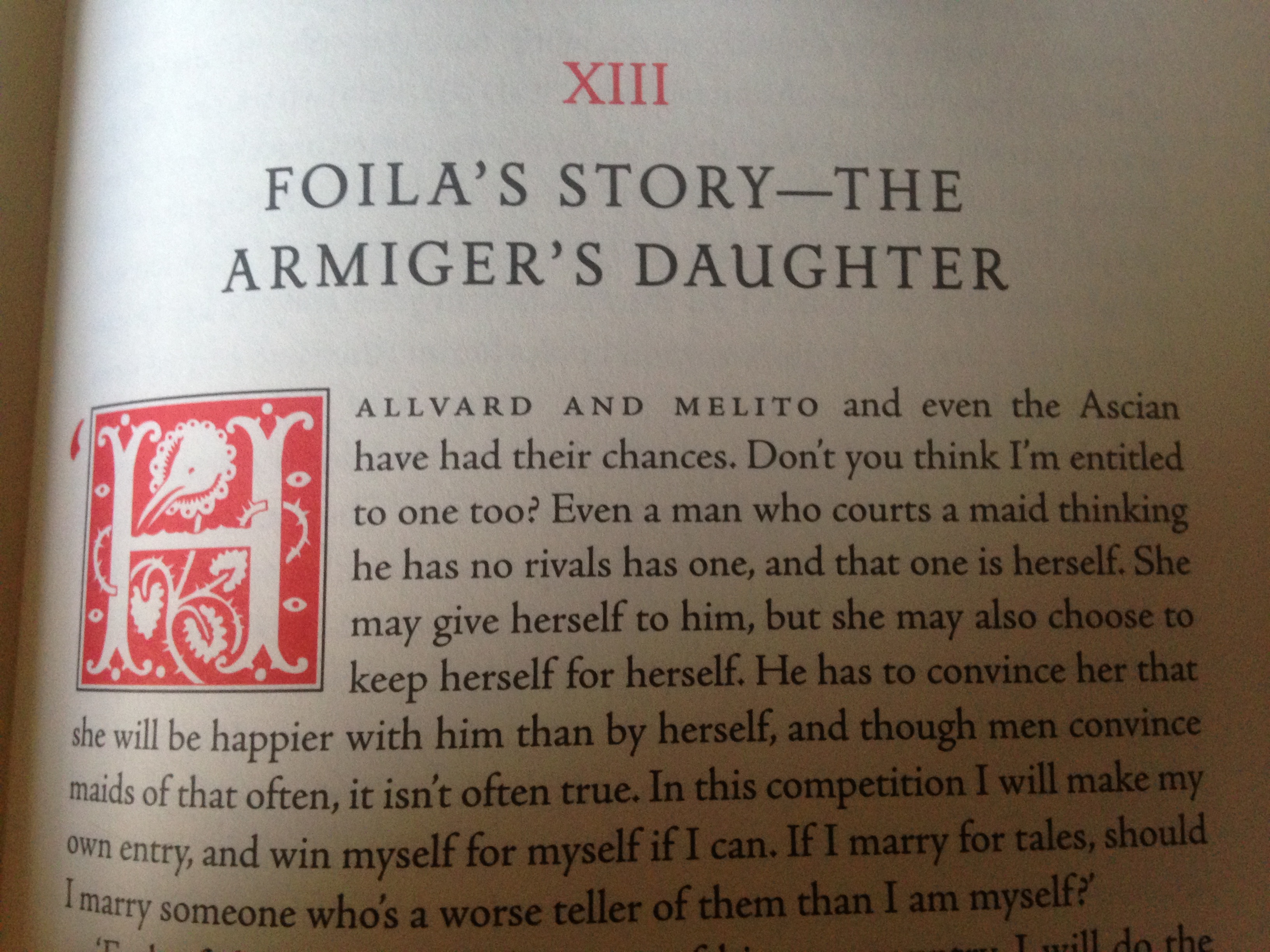
For those unaware (or who missed when I spoke of it before) this sequence is framed around a story contest among the soldiers recovering in the lazaret. Folia, who has found herself with multiple suitors hoping to marry her and settle down, announces that the best storyteller (as judged by the weirdo in the black cloak) will be the winner, because she doesn't want to have to spend winters with boring stories.
Between each story, there's a chapter spent on a conversation between Severian and one of the Pelerines in the field hospital
The format is great as well - after the parties are introduced and the rules laid out, we get a chapter dedicated to one of the stories, then a chapter dedicated to Severian conversing with someone in the field hospital about something else. It's a nice breather, a splash of color and variety, a look at the world and people outside of Severian's myopia, and ends with the first of...four? (Lazaret, Sand Garden, Dorcas, return to Citadel...yeah, four) emotional climaxes of the book.
In order, it goes like this:
- Chapter 7) Hallvard's Story - "The Two Sealers"
- Chapter 8) Severian speaks with an unnamed sister of the Pelerines
- Chapter 9) Melito's Story - "The Cock, the Angel, and the Eagle"
- Chapter 10) Severian speaks to Ava, a sister of the Pelerines
- Chapter 11) Loyal to the Group of 17's Story - "The Just Man"
- Chapter 12) Severian speaks with Winnoc, a slave of the Pelerines
- Chapter 13) Folia's Story - "The Armiger's Daughter"
- Chapter 14) Severian speaks with Mannea, directress of the Pelerines, and returns the Claw to its altar.
Hallvard's story is one of grisly murder in his own family, where one of his uncles kills another over breaking an oath. it gives us some minor details of the southern islands - that land is inherited through the matrileneal line, that Erebus sends raiding ships, that when a man dies they will hang a painted sealskin in the home until no one alive remembers the man it memorializes.
Melito's story is an animal fable - a rooster grown much to full of itself challenges an angel to a duel, attempts to back out as a coward, and the angel has him killed by an eagle. Melito describes it as the worst story he knows (and that if he wins on his worst story, Folio will have many better ones to listen to in the future.
Loyal to the Group of 17 tells a story - with Folia translating his rote proverbs on his behalf - of a man mistreated by the other members of a collective farm. He goes to the capital to file a complaint, returns, and is beaten again. This cycle repeats three more times, until at last the other farmers grow fearful that the Group of Seventeen will at last act, stirred by the Just Man's persistence.
**
I'll use this segue to talk about how much I love the Ascians - both for the sheer horror of their brutal hive-society and the enslavement under Erebus, and the fact that Wolfe does not withhold humanity from them. Anywhere else, any other story, they would be the faceless, unquestioned enemy - and the Ascians themselves are explicitly trying to eliminate individual identity and all traces of what we would call humanity. But even with all of that, we see them as they are - slaves of a power they cannot resist. Desperate, starving, held by such great despair and deprivation that many kill themselves the moment they have weapons in their hands. Stripped of language. Treated as machines to such a degree that they leave the dead where they fall, don't bother to repair their own war machines, don't bother setting guards because they cannot conceive of escape. Their endless ranks stretch from horizon to horizon, and are filled with children, old men, pregnant women.
And, as we see with Loyal to the Group of 17, their humanity is not completely extinguished. Even Severian - even Severian! - can see this.
This is Wolfe at his very best.
**
Well, we're here. My favorite part of all of Book of the New Sun. After 3.5 books and countless misogynistic rants and episodes of abuse - at long last, we have reached the point where Severian finally - finally - shuts the fuck up and lets a woman speak for herself.
Character development, everyone!
Several factors go into this, I think: First and foremost he is on the brink of death from starvation and fever, to the point of hallucinations. Difficult tomake an argument in that state. Secondly, this is a development on what we saw with Cyriaca - who was the first woman who got to say her piece, but Severian was still doing his creep thing throughout. Thirdly, and the one I put a lot of emphasis on personally, is that Folia is a soldier - she exists outside the hierarchy of male and female that Severian has constructed for himself. And so, in his weakened state, he cannot summon the means to build a box to put her in.
With Severian no longer able to maintain his editorial filter, we get a glimpse of people as they more accurately are - and lo, it turns out that women are autonomous beings and this woman is exercising her agency.
It helps, as well, that her story is the richest and most complex of the four. Superficially it is a folktale, but I suspect she is metaphor-making of her own position. (A self-possessed woman offers a challenge to three suitors - sounds familiar, no?) The Armiger's Daughter has released a bird into the world, with a ring around its foot. The man who returns the ring wins the right of marriage.
The Lark appears in human form to all three suitors - it is characterized both as bird and as angel, and more indirectly as the Armiger's Daughter (read: Folia) herself. Suitors 1 and 2 both try to fight and kill the Lark-Angel-Woman, hoping to take the ring round their boot by force. The third, though, listens to what she has to say, and becomes her companion on a long journey (he is offered the quick path to his goal, and the good path. With the wisdom afforded only to folktale heroes, he chooses the good over the quick) where they have many swashbuckling adventures and at last return to the Armiger's manor home, to find the Daughter there, with the bird tweeting happily in its cage (for birds return to their roosts). They marry, and all is well.
**
The story contest does not have a conclusion - while Severian is off visiting Master Ash, the camp is bombed by the Ascians and the soldiers in the lazaret are killed. Severian stumbles across Folia at death's door, and with her last words she asks that he share the stories. (Severian says he kisses her; in a moment of perhaps too much credit to Severian - and also wishing to maintain thematic wholeness and hold onto that character development - I imagine this as upon the forehead.)
We do not know which story he would have picked as the winner.
For my part - Folia's the winner by a country mile. I think that there may have been a chance that she would choose Loyal to the Group of 17, but that is a could have been.
**
Wind back the clock a bit.
**
"I am saying that the things we love in others and admire in ourselves spring from things we do not see and seldom think about" (8)
**
Severian feels relief at the greater world's ignorance of the torturers - reaffirmation that they are nothing, in the grand scheme. More character development. (8)
**
In the lazaret there is a soldier named Emilian, whom Thecla knows, and Severian speaks to him in Thecla's voice. (8)
**
Ava gives us a lot of interesting tidbits: the Pelerines are a mostly aristocratic order (explaining the exultants we keep seeing among them), other religious orders are more open to the lower classes (though we do not see them, except perhaps a mention in passing comparison as Sev leaves Agia's shop in Shadow). Captured Vodalarii seem to have become cut off by their inherited memories, entering an analeptic-triggered solipsism (which Severian has avoided, thanks to the Claw).
She says also three ways that humans might lose their humanity
- There are those who give it up willingly (Zoanthropes)
- There are those who lose it without intending to in seeking to enhance or transcend it (Baldanders)
- There are those who have it stripped from them (the Ascians)
I propose an additional fourth
- Those who repress their humanity through their devotion to another thing (torturers)
(10)
**
"Let those who cannot be just be kind" - this is from Loyal to the Group of 17. Even in the depths of their oppression, even in their own prescribed speech, humanity lingers (11)
**
We learn from Winnoc that Palaemon was once exiled from the order - and thus is the master who argued for his release. (12)
hey, isn't it funny that Gurloes doesn't really factor into anything when Sev returns to the Citadel?
**
"The darker a man was, the more of a slave they made him" - the idea that the institution of American racism was a grotesquery of such enormity that memories of it linger until the very end of the posthistoric era feels...appropriate. Alas, its memory seems to have outlived baseball and blues.
**
Winnoc calls the latrines "the jakes" which means that Wolfe knows what the jakes are, and this weird little phrase is like a secret code-word to the cool kids club. I learned of it camping with my father.
I miss him. I don't think he ever read these books, but I suspect he would have loved them (12)
**
Severian describes the Pelerine rites as "more beautiful but less theatrical" than those of the torturers, which certainly checks out. (14)
**
Some prime emotional catharsis from Severian returning the Claw. (14)
**
Master Ash is a return to the "curiosity every chapter" format of before - he is a researcher from a timeline parallel to that of the Green Man - a future where the New Sun never comes, the world is frozen over, and the few remaining humans are ferried offworld by the Heirodules. Mannea wants him pulled away for his own safety - I wonder if she is aware of his true nature (17)
He, like Meschia, has his last / first woman, though we do not meet her.
**
"Men of religion tell comforting things that are not true, while men of science recount hideous truths" - yep, got us dead to rights there (17)
**
Sev claims again that he misses Valeria the most, while providing no reason - nothing new there. What is new is the line "I was only a boy...thought I didn't think so then." Character development! (18)
**
Midsummer = New Years Day. Thank the gods, something sensible.
**
There is a mysterious asterisk in Citadel 19 that represents an elision of time. It is the first time it occurs, and it will occur several times more.
**
And back to Severian the creepshow with Daria. (19)
**
The battle (and its buildup) are great - I love all the different units in the Commonwealth military - each unique from the rest, really driving home that Autarch-is-the-Commonwealth idea before its even introduced. You've got kinda regular hillfolk contrasted with the more professional units, you've got Severian's band of mercenary light cavalry, you've got the beast-men soldiers and the anpiels, you've got confirmation of clone soldiers (what then, of Valeria?) you've got the Daughters of War who are all Rubenesque vestal virgins riding on god-damn arsinotheriums. Even the Acsians get in on it with their weird five-limbed fliers and a unit entirely of dwarves riding on giants (22)
**
You can tell gene Wolfe had military experience (which he did, in Korea) with his portrayal of battle - equal parts waiting and terror, and more importantly Severian's unit is not some heroic lynchpin - they're light cavalry, they harass and apply pressure. The main fighting is elsewhere in the valley. Sev gets wounded, but not in a cool or heroic way. And in the end it is just one battle, that had no great outcome. I appreciate all this a great deal (22)
**
Love the Autarch and his mammoth. Mammoths being great in general. improve any story they're in, mammoths. (23)
**
"As a boy, I was often told I lacked imagination" - I feel like his memory has something to do with this. (23)
**
And just in the middle of major plot developments Severian drops the bomb of half the apprentices in the Matachin Tower died before reaching journeyman. HALF. 50%! The section of Gyoll he swam in and nearly drowned in as a child is here described as more or less an open sewer! Malubrius coughing up blood and yet never seeing a doctor as he's dying makes a whole fucking lot more sense now!
And, if we are to buy the theory that the Claw has been resurrecting Severian without his knowledge over the course of the book (I buy whole-heartedly into this, and not only for comedy purposes), and he says he never had much worse than a head cold as a child - how many times did he die and revive from the conditions in the Tower? (23)
**
Another asterisk (23)
**
I love the autarch's attitude towards rule - why shouldn't I appoint myself to a bunch of minor positions? A letter from the Third Bursar is sometimes exactly what you need, when something from the desk of the Autarch is too much. (23)
**
"There is no limit to stupidity. Space itself is bounded by its own curvature, but stupidity continues beyond infinity" - My god, he admits it! (24)
**
The Autarch, must be mentioned, has cat-lady bodyguards. No word if they are radical anarchists. They call him 'Legion', which is neat and also very appropriate. (24)
**
I do really like the big reveal of how the Commonwealth works vis a vis the Autarch - the Autarch serves to protect the commons from the aristocracy, the aristocracy serves as a barrier between the commons and the Autarch. The Autarch is composed of people from all walks of life - most of them lower class, many of them criminals - so that he can use those inherited experiences to make better judgements. It's almost a case of benevolent tyrant (empathetic tyrant?), but as the Autarch tells us "Your error lies in thinking I am at the bottom of everything. No one is." (25)
**
The bombshells keep getting dropped - Thecla was indeed working for Vodalus, and was captured by guards of the House Absolute and shipped off to the Citadel for that reason. Confirming that Severian's weird loyalty to Vodalus is, in at least part, the result of inheriting Thecla through the alzabo. That doesn't explain to me why he has those thoughts in pre-Thecla points of the narrative (as Sev generally does not mix mindsets while writing, given how his memory relives things) but I find it suitable explanation on the whole.
Also worthwhile is the notice that Vodalus' hidehout was a mere dozen leagues (~36 miles) from the wall. Don't know who he thought he was fooling with that. (25)
**
Severian forgets, or appears to forget, or hypes himself up into forgetting, for the first time here (25)
**
He says that the House Azure was an "odd name" he came to understand, but no clarification follows. Typical. (It's called the House Azure because the building is fucking blue, Severian) (25)
**
The current autarch was approached by his mentor, Paeon (whom we will know later as an aquaster) on the night in the House Azure and told that Severian was the next in line. We have ourselves a setup. (25)
**
Agia re-appears once more, now having enlisted in the Vodalarii as her way of getting the battlefront and across into Ascian territory, just to get her hands of Sev. Talk about dedication. (26)
**
I have spoken of the doctor (and Severian's odd behavior) previously, but additionally is the revelation that, apparently, corpse-eating is common among the psychician's class, and doctors do it much more effectigvely than Vodalus. Which brings up why Vodalus has not bothered to do this more effective method. Or he is completely unhinged, as indicated by everything else he's said. The guy casually drops that he does horrific human experiments (26)
**
In his imprisonment, Severian discovers hauntology -"We all have in us the ghosts of long-vanished things, of fallen cities and marvelous machines" (26)
**
Sudden cut to present (Severian as he is writing things), where he describes the levels of transcendence and the rituals therein: Stage 1 is Aspiration (Private prayer), Stage 2 us Integration (Public Worship), 3-5 are unknown, 6 is Assurance, 7 is Assimilation, both undescribed. (28)
**
Back in the past: Jesus his knee and thigh are absolutely fucked from his injury during the battle. (28)
**
The women who serve Vodalus all joined for reasons disconnected from his actual motives, and none of them wish to remain in his service. Worth nothing (28)
**
The alzabo inheritance is similar to not distinct from the autarch inheritance, which puts me in mind of mentions in the first Vodalarii camp that the Heirodules had some similar treatment and could recognized alzabo usage. (29)
**
Here near the critical moment, Severian admits to the Autarch that he had hated him, and the Autarch answers that he was right to do so - that "until the New Sun comes, we have but a choice of evils" and the evil of the Commonwealth is to trap itself in stasis (whilst Ascia pursues progress in the name of making all humanity unified in thought and deed)
**
Severian alsmot immediately after becoming Autarch sequesters Severian the Torturer as another person (30)
**
Agia kills Vodalus offscreen (and as we find out in Fr. Inire's letter later on, replaces him as leader of the rebellion), so I think now's a good time to bring up how much I love Agia / Vodalus as a Satan figure (some will say that Typhon is the Satan figure, what with the temptation in the desert, but I feel like that is entirely too Protestant for this book, hear me out)
So Actual Biblical Satan is a nebbish lawyer on God's payroll. Exposure to Zoroastrianism and Hellenic Syncretism (and then Milton and Dante) lead to our modern conceptualization of the character as a sort of adversary on seemingly equal footing to God (American Evangelicalism: whoops it's actually Manicheism!) That is totally out of line with the Catholic view that evil has no substance of its own, but is instead a lack of good (I will give Augustine of Hippo one (1) good idea gold star for that one and then return to wishing that he had been mauled by an actual hippopotamus and spared us everything else he said).
Wolfe plays his Satan analog a lot like how Tolkien plays Melkor - a force that, while dangerous in the here and now and on the scale of the characters, is ultimately ineffectual on the cosmic scale because they have set themselves against a force that can play them like a fiddle and twist everything they do into service of a greater cause.
Both Agia and Vodalus are obsessive losers, consumed utterly in their hatred of the conception of the Autarch / Severian that they have constructed in their head (I appreciate that this is spelt out directly - how simply Wolfe is able to lay bare the foundations of senseless hate) and incapable of actually ever hurting their targets in a meaningful way. (30)
**
And now, the aquastors appear and we get yet another series of bombshells - the Green Man was working on behalf of the Ship, which is now projecting aquastors (constructs formed by the subject's memories of figures they knew) of Malrubius and Triskele to Severian - and thus all those apparent hallucinations were the aquastors reaching through the Corridors of Time. With Paeon being a similar projection (and with the great history of time to be revealed shortly), it's made abundantly clear that Severian is the result of a major undertaking. Abaias and Erebus are directly stated as trying to stop or subvert it. (30) We get roundabout terms of what is to follow - go out beyond the planets, stand trial (31)
**
I love how Aquastor-Malrubius admits that he's a deus ex machina. (30)
**
Gelding as the punishment for failing the trial makes little sense to me - You would think, if that's the only downside, there would be a great number of Autarchs who have already had children and don't plan on having more, or who would think "eh, whatever" - like I can see why it would be a terrifying prospect for Severian (as most of his neural power is tied up in his dick and his conceptualization thereof), but the "no children, no heirs, no inheritance of the throne" makes no sense if it's applied only after the test - because any autarch's children wouldn't inherit anything if the process was completed according to spec normally, and the neutering wouldn't do anything to stop children who already existed from learning the passwords. (31)
**
Ymar was the most recent to fail, before Appian. He is, we learn, in Urth the first Autarch, and I dislike that premise quite a lot and preferred it when it was vague and unanswered. (31)
**
And the Claw's little time-loop has it's beginning - a rose bush on the beach. (31)
**
"The idea is absurd. But then, all ideas are absurd." (31)
**
There are children among the former autarchs. Which, while it speaks to the breadth of experience the Autarch possesses, it's also horrifying. Alzabo Soup suggests that in there cases there might have been more palatable means of transferral, but after transfer, life is going to be hell and a half for anyone, let alone a kid. (32)
**
There are many ships described at the mouth of the Gyoll, but no port. Which is a really weird omission - either by the Commonwealth as a civilization, or Severian as narrator. If you've got a major river emptying out into the ocean, even one as heavily-polluted as the Gyoll, there's going to be a city there. That's how humans work. Even when it's a terrible idea (like New Orleans) we'll stick a city there.
**
The journey aboard the Samru is 20 days - the longest elision of time we get in the entire series. Also, more theatrics. (32)
**
Finding Dorcas in the ruins is the point where I say that yes, even Severian is capable of positive personal change - he says nothing, he does nothing, he does not intrude or overbear - he recognizes, without being told, that he would not be welcome here.
The boatman is here, which says to me that Dorcas knew where to find him - as I recall him saying in Claw that he rents a room near the gardens from a friend. I do not know how she would have learned of his presence.
Another scene I love a great deal. Excellent emotional closure. (32)
**
One of the prior Autarchs must have been a sailor or a very hyperfocused maritime scholar, because Severian sure does know a lot about how boats are made now. AND HE WILL TELL IT TO US IN DETAIL. Also, the sailor's rowing song again - perhaps it was the Samru we saw in Claw (33)
**
I like how, on Sev's return to the Citadel - even though he has been gone only a short time - everyone else seems much older (Palaemon, the Castellan) or much younger (Drotte, Roche, Eata) (33)
**
Palaemon, we must remember, was quoted as saying that clemency was the illness of the age. But he is the one who argues for Sev to be exiled, instead of killed. A hypocrite for good, in the end.
Still, he argues for the guild's continued existence against Severian. Sev's track of logic is an interesting one - he is very much concerned with the damage done to the torturers perhaps even more (or at least, more focused upon here) than the clients. Palaemon says that torture must be carried out by good men and they cannot afford to have it be carried out by evil men (he's very much in a "I must justify these means" state of mind) - but, of course, Severian is right - men made to do monstrous things will, in short order, become monstrous themselves (33)
**
"The state is everyone else...we are the people, the Commonwealth" - while this is true, and we get confirmation here that most Autarchs were lower class or 2nd rate scholars or minor bureaucrats (ah, if only), I find myself disappointed by Urth narrowing how many we hear and see. Sure it's economy of storytelling - Roku, Kyoshi, Kuruk, Yangchen, and then the undefined masses - but a few more beyond Appian would have been nice. (34)
**
In a repeated theme of "Wolfe off-handedly mentions something incredibly fucked up", there's the woman in the dungeons who makes furniture out of children. (34)
**
Another asterisk elision (34)
**
Right then, Time for the Secret of Time
- Time is cyclical, a series of repeating universes expanding and contracting. They are not called kalpas, but I shall call them kalpas.
- In one kalpa - the previous one, if this is to be believed, a species very much like but not entirely unlike humanity was able to, by the close of the universe, create beings like them, who in turn were able to grow into a form that could escape the end of the Kalpa into Yesod - the realm above our cycling universe. From that vantage point, they can see all time and space. (We learn in Urth these are called Hierogrammates)
- The Heirogrammates discover humanity of Severian's universe, and recognize that they could, in time and the proper preparation, rise to the status of the Heiros (the near-humans that created the Heirogrammates). They build the time-ships and construct / recruit heirodules to crew them, and then observe and faintly interact with humanity over ages.
- "Because it is as cruel as the means by which themselves were shaped, there is a conservation of justice; but when the New Sun appears, it will be a signal that at least the earliest operations of the shaping are complete - in light of what we learn in _Urth_...god I fucking hate this passage. It reads like Twitter's Main Character of the Day going "I don't believe that people should have debt relief or access to medical care because if I had to suffer through it, so should you" and guess what, that's exactly how Urth turns out (more on that later)
**
Back to earth, comedy with the locked doors in the Citadel, followed by the Autarch's chambers. The mandragora in spirits (read: an embalmed fetus that is able to psychically reflect the viewer's thoughts and thus appear to speak - and is either sapient enough to desire death, or merely recites lines that the viewer would consider appropriate.
We are introduced to the 'fabled emerald bench', and told nothing else about it. I appreciate a good shitpost like this, and thus from hereon I shall address this only as the FABLED EMERALD BENCH and hedge my entire interpretation of the Solar Cycle wrt the connection of elements to the FABLED EMERALD BENCH (35)
**
Fr. Inire's Letter contains a great many important details
- Agia was set in place to replace Vodalus as head of the rebellion.
- The battle of prior chapters was a pretty standard engagement in the war.
- More soldiers are needed; units need replenished, replaced, moved.
- Seditious units need pacified
- We need to buy more equipment from the other heirodules (high-ho war profiteering! AWAY!)
- Inire warns that the Ascians might be able to break through the lines in the coming year, and encourages preparation in case it does happen
- The time-ship is considered inadequate, but it was all Inire could manage to get a hold of
- there are two other servants by the names of Hormisdas and Olager, who are dealing with Abaia in some manner. We hear nothing else.
- Urth is considered of minor importance by the greater powers, when compared to the many human colonies across the stars, and even then the Commonwealth is considered to be not particularly notable when compared to the Ascians, the Xanthoderms, and others.
We get in Urth that the Xanthic Lands are islands west of the Commonwealth. Judging by tectonic patterns (if they hold true before Urth's core fails ... Actually, if Urth's core has died then there shouldn't be much of a magnetic field - I don't think anyone uses a compass) I would suspect that they would be located either in the Easter, Galapagos, and Juan Fernandez hotspots - or more likely they are a series of new (to us) islands and perhaps some older ones like New Zealand or Polynesia, formed by the subduction of the Pacific Plate underneath the Australian.
I also believe that the name is literal, and that they do indeed have golden skin, though there is always a case that there's a bit of in-setting racism going on (as we have seen evidence of previously).
**
Talos returns with a false coin, the same as Vodalus' from so many years ago. There's a lot to be said about Sev's "symbols make us" etc etc, and frankly we can summarize all of that down to this this - men will invent symbols even where there is no reason for there to be one, and even when they are false they will shape the people who exist in their sphere of influence.
Also does this mean Vodalus kept around counterfeit coins as a cheap means of bribing common folk who wouldn't know any better?
**
The last Autarch in the citadel is older than the shared memory - which, considering what we learn in Urth, means that the project did not begin until well after Ymar. (36)
**
Using the laser pistol to light a fireplace = more comedy gold. (36)
**
The incident with the sailor, describing an enormous boat going the wrong way down the river, followed by the voices of women and one very large man - Abaia and the Undines obviously for the latter, less clear on the former. They know what is going on, and seem to be panicking. (37)
**
"That ignorant and innocent man I killed with his own axe" - Well shit, that finalizes a lot of context for the graveyard scene. Makes sense, though - Severian is rather violent regardless of context. (37)
**
Right then. Sev has gathered the lads together to solve the mysery of the note from the Inn (which he has already solved, but not mentioned). To whit:
- Note was written by Ouen, the waiter at the Inn of Lost Loves.
- Ouen is the son of Dorcas and the Boatman
- Ouen had a lover named Catherine, who was taken in by the law.
- Catherine was a runaway from an order of monials, which we can presume is the Pelerines
- (This means that she was, as Ava established, higher class - an armiger or even exultant. Thus explaining Sev's height.
- Catherine was taken to the Citadel to be imprisoned, where she gave birth to twins, Severian and Severa, and then died.
- Ouen has no knowledge of any children from any of his lovers
- Severian unwittingly fucked his grandmother
- But at the very least he gives Ouen the gun and directions to find Dorcas, to help them out
Now, many words have been spilled about who Severian's sister actually is. I've seen people throw out Valeria, Merryn, Agia, and I consider all of those to be incredibly silly and missing the point. Remember the FABLED EMERALD BENCH? Wolfe loves nothing more than throwing shit into the story with no explanation.
So my theory is that Severa never appears at all in Book of the New Sun. She was handed off to the Witches' tower, and if conditions there are comparable to the Matachin, she is most likely dead. Coinflip odds.
**
All right. Final chapter. The Bigger, More Secret Secret of Time
Severian claims (though with no hard evidence whatsoever) that there was a prior Severian - that the events we have just read played out in similar fashion, and a torturer became Autarch. he claims that there was no Claw, but events played out more or less similarly. He then wandered the Corridors of Time, for reasons unspecified.
(Alzabo Soup uses First Severian as an explanation for conflicting memories - which is a good theory)
Again - Severian has no proof of any of this, or if he does he does not provide any. But let us assume that he is in fact accurate. Here is my theory:
First Severian goes through his own journey to the Phoenix Throne. He is either subverted by Abaia (since it is said that the Undines are interested specifically he will be a torterur-Autarch), fails at the test, or never goes on to take it. In the case of the third, which I favor, First Severian is unable to stabilize his rule over the Commonwealth / Urth - perhaps losing to the Ascians, or suffering a revolution of Exultants and getting ousted, or a hundred other things. he is never able to take the test, and the hour is so dire that there cannot be another Autarch - there's no time. Severian or no one.
First Severian, having failed, bails into the Corridors of Time (likely ushered in by the Ship and its Aquastors)
So, since there are no other options and Severian _must_ be the Autarch to bring back the New Sun, a plan is made (potentially by the prior Severian, or by the Ship itself. The Green Man recruited into it, and potentially Fr. Inire aware of it. Of other heirodules...they have to be involved but I can't see how.)
With the timeline effectively rebooted, we get the journey we just read, of Severian 2.
Now, we're going to get a bit wild for those of you who had not read Urth, scroll past this segment if you want to avoid it.
The Lexicon Urthus hypothesizes no less than 8 iterations of Severian. I disagree, and instead have the following
- Severian 1 - Alpha-timeline Severian. The one who fails in the mission and goes onward to wander in the Corridors of Time. I think he's the one who builds the tomb in the Citadel graveyard.
- Severian 2 - The Severian we all know and love-hate. Creates the Claw and goes on to die by falling down a maintenance shaft on Tzadkiel's ship (without the Claw to aid him, it seems his lifetime of resurrecting every time he gets himself killed is no more - wait but he still has the Claw, he gives it to folks in Typhon's time...fuckin' hell)
- Severian 3 - An aquaster made by Tzadkiel. Completes the trial, becomes the New Sun, goes into the past to become the Conciliator, returns to future just in time for the flooding of Urth, dies in a Very Confusing Manner (?)
- Severian 4 - Apu Punchau - who might be Severian 1, but is more likely a second aquaster iteration of Severian 3. Killed by his people, resurrected by the Cumaean, fuses with Severian 2 at the end of Claw (thus explaining where all that sudden mental stability came from.
- Severian 5 - Another aquaster, generated after Apu Punchau is killed. Goes on to the future of Ushas, writes his account in Urth of the New Sun.
God I have been writing this a while, I had completely forgotten about my "Sev merges with Apu Punchau in a sort of temporal paradox waveform collapse, and Hildregrin is caught in the blast radius.
**
And now, the end. Retracing his own footsteps to Valeria. And even though we never learn who she is, I find this, ultimately, extremely narratively satisfying.
Regarding Urth of the New Sun
I will not be going into great length (this, I - the Dan of the future from when I wrote this, which was actually prior to finishing the section on Citadel - must inform you is a lie) on Urth of the New Sun here, as I've found that as time goes on and I think more about it, I like it less and less. As tends to happen with these sorts of developments in narratives, the things I previously enjoyed become of lesser importance, and the things I did not care about before are given a spotlight (I do wish this would stop happening). It's still Wolfe, for all the good things that entails, but it is a drastic stylistic shift (one I did not particularly care for) and its climax hinges on a premise that I do not consider valid.
It would be, using only Book as a base, easy enough to view the catastrophic flooding of Urth as a tragedy with Sev acting as an unwitting stooge to the very end for his part in it. Urth makes that stance significantly harder to maintain, and this is the great stumbling block: I don't think that the Flood narrative is salvageable as a piece of literature without taking a hacksaw to it, and Wolfe has never been one for battlefield amputations. While he is, on the whole, more thoughtful in his philosophical Catholicism than any author who is not Gene Wolfe, he is still unable to overcome "the deaths of millions are an acceptable loss in the divine plan" and its inherent moral repugnancy. "All the world is corrupted and sinful" is a cop-out justification avoiding the issue of countless dead innocents and a divine force that would rather kill everyone instead of lending any meaningful material aid to those suffering.
So it is, with Urth of the New Sun: humanity is judged in absentia for crimes no one alive committed by the Heirogrammates, who care about them only so much as to prevent any competition from a violent and aggressive interstellar humanity (thus is their justification for crippling the sun) and as the eventual source of the next generation of Heirogrammates (we are, it seems, a necessary part of their reproductive cycle, which will require the New Sun to proceed).
Severian, as Autarch, is representative of humanity - but he contains only a few thousand minds within him. The millions remaining on Urth get no voice, and even if they did, it would not matter. If Severian failed his test, they would all die. If Severian passes his test, they would all die. It is meaningless, to the teeming poor of Nessus, that their Autarch has travelled beyond the boundaries of the universe and conversed with the greater powers - visiting Yesod does not suddenly make bread for the hungry or grant any relief to the downtrodden. They will die, evil and good alike, and there will be no justice in this because the good, or at least the mostly good - the decent and the mostly-so - will have none of the worldly benefits afforded to them by evil acts and their deaths will be mere capstones on lives deprived of peace and prosperity.
At the end of Citadel the aquaster posing as Malrubius tells Severian if it is better to have mercy and justice, or the material benefits that the New Sun might bring. Severian admits that the New Sun is needed first, and that mercy and justice might come later. And in that framework, perhaps the coming of the New Sun might be swallowed as a terrible, horrific thing, accepted only because all other options have all been spent and we are running out of time.
Which is all thrown right out the fucking window in Urth with the addition of the literal godlike being in a fucking time-travelling spaceship.
I re-iterate: Tzadkiel can play space-time like a fiddle (the Ship we meet before is more of an autonomous drone). They are not God but they are operating at the level where the distinction is academic. They have incredible power - they have the ability to help - and they do jack shit. They do jack shit about the megatherians, they do jack shit about the material conditions on Urth, they crippled the sun because humanity was dangerous but they didn't lift a fucking finger to try and teach us not to be. We're just supposed to pull ourselves up by our bootstraps out of the poverty and ignorance that the Heirogrammates directly caused and have continued to maintain.
Was Typhon a terrible dude? Yes. Did he need to be stopped? Yes!
But when you're a literal godlike being in a fucking time-travelling spaceship, you have a whole lot of options at your disposal, AND MAYBE THE ONE THAT HURTS THE PEOPLE VICTIMIZED BY TYRANTS LIKE TYPHON MORE THAN TYPHON HIMSELF IS A FUCKING BAD CHOICE YOU UTTER BUFFOON, YOU COMPLETE AND TOTAL NIMROD, YOU ABSOLUTE JAGOFF.
INHALE
EXHALE
PAUSE
What a wild thing, what an absolute bugfuck response; to see a band of starving, terrified apes and to witness the horrible things they do so driven by hunger and fear, and then to not only do nothing to alleviate the starvation and terror that fuel their evil acts - when it is entirely within your ability to alleviate it all - but to make the material conditions worse and then blame the apes for not overcoming a more difficult world than what they started in.
inhale
exhale
pause
You will recall that I once worked in a group home for sex-offenders. Whatever the worst thing you can imagine is, hearing that statement, I can assure you that it happened, and that knowledge of worse things still have been seared into my memory. I have met Severian, multiple times over, though I did not read BotNS until years later. I came out of that experience firm in the belief that we must, as a society, extend some measure of mercy even to Severian - but it killed on the spot any patience I might have for people who make arguments attempting to explain why the divine will not come to the defense of Severian's many victims - and furthermore, to argue that this is acceptable in the grand ordering of the cosmos, to argue against even the slightest whiff of anything that might alleviate pain and suffering because their God is a torturer.
(The mystics, with their God-as-Action and God-as-Becoming, they have better arguments to stand on. But they are not the orthodoxy, and they are busy meditating atop their pillars, and so I will leave them be.)
Gene Wolfe, for all his many strengths as a writer and for all my love of his work, cannot convincingly square this circle, and Urth of the New Sun is a worse book for the attempt.
(Also it opens with Severian nearly killing himself on an unattended, no safety tools spacewalk, and that is suspension of belief shattering. Not that he'd do it, which he absolutely would regardless of the prior autarchs' advice, but because apparently he was never given a handler and Tzadkiel's ship apparently has neither maps nor a PA system. Or Severian might be an idiot and just never asked)
(Also none of the answers we got were much more satisfying than what could be surmised from Book, and in some cases (Ymar in particular) were worse.)
(I can't say don't read it, but I can say "read it once and proceed to forget most of it" as your best bet.)
Final Notes
What a good book (except for Urth). What an excellent god damn book (except for Urth). Magnifique (Except for Urth). The next re-read, I am certain, shall be just as fun. And will not include Urth, unless Alzabo Soup reveals some great transformational information.
There are many more things to be said but I have gone on long enough.
Thank you all for reading along on this journey with me. I probably got a whole hell of a lot wrong, but it was a great time.
Also I wrote like, over 10k words in the space of two and a half days holy shit the new meds are working.